Running Away to Colombia—Part 5
“Look at me. I can walk again.”
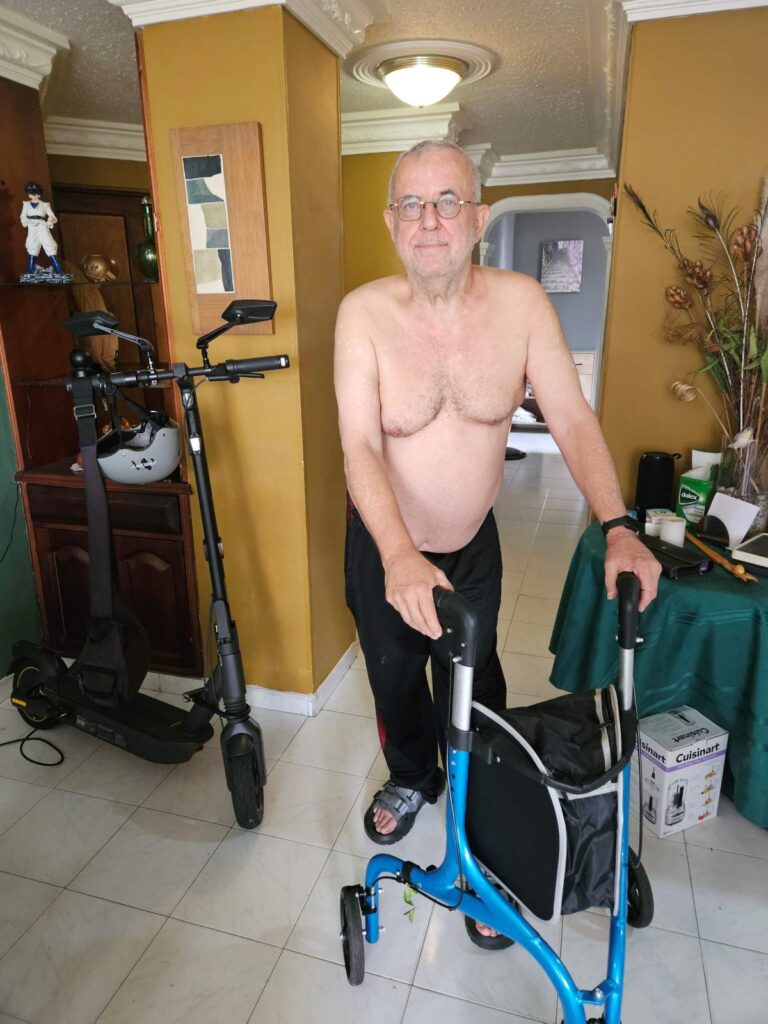
But the blue walker is the one that will commandeer this one.
That was where I left the story. It was true.
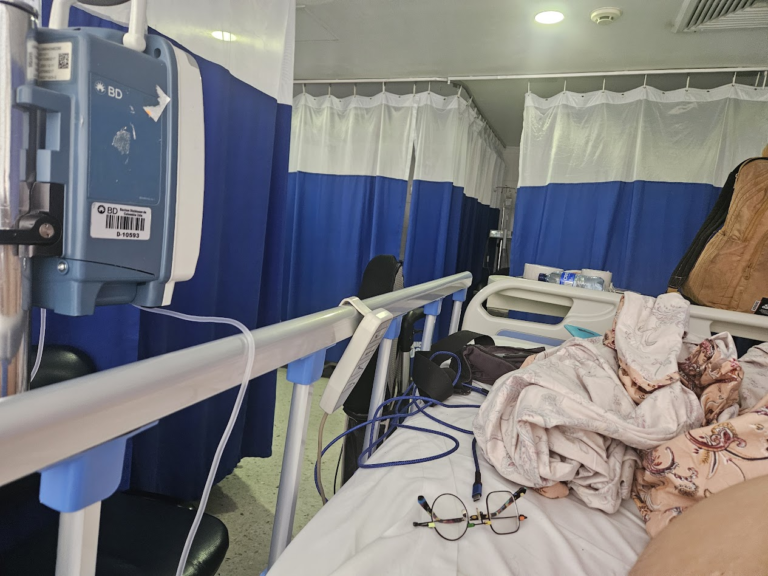
The day after the ablation procedure, a physical therapist came into my hospital room, helped me stand, and assisted as I walked down the hallway with my Caribbean blue walker. Just ten days earlier, paramedics had lifted me out of my own bed in a bedsheet because I could not move. Now I was walking again.
The procedure was considered successful. I later learned that pain-medicine studies often use about a 50 percent reduction in pain as a benchmark for a successful radiofrequency-ablation outcome.
Fifty percent.
That sounded reassuringly scientific until I tried to think about it scientifically. Fifty percent of what? Pain was never a fixed quantity that could be objectively measured. It changed with the hour, the position of my body, whether I was lying down or standing, whether I put weight on my right leg, how far I tried to walk, and what drugs happened to be circulating in my bloodstream.
How does a patient measure half of something that was never measurable to begin with? How does a doctor quantify it from outside the mind and body that actually feel it?
Maybe that question should have alerted me to some of the things that came later. Fewer things feel binary anymore: success or failure, stay or go, better or worse, safe or unsafe. The chessboard, if not the rules of the game itself, changes every morning.
A minor nuisance can become a crisis. Something that looks like a crisis can turn out to be something as simple as a missing document found an hour later. And something called a successful medical procedure can give me back my ability to walk while withholding the life that I had before.
Back to the Nest
The hospital actually gave me some latitude about when I wanted to leave. I suspect that they would have kept me as long as I was willing to keep paying, but as soon as they told me that I could go home, I said yes. I was more than ready.
The discharge papers were finally signed on Saturday, July 4, after the usual hospital ritual of waiting for hours for somebody somewhere to produce the necessary documents that would allow me to escape. I do mean necessary. In Colombia, hospital entrances are secured with armed guards and metal detectors. No papers, no exit.
Jackson and Michael were there with me. While we waited, I practiced walking. I could do it, but it was not a good walk. There was no longer that crippling pain. Instead, my muscles felt weak and unreliable. I tired almost immediately. Other parts of my lower back began aching—not the spine exactly, more like muscles protesting that they had suddenly been asked to carry a load again after weeks of doing almost nothing. A walk around the ward left me immobilized until I rested and recovered enough for another go.
An attendant wheelchaired me to the hospital entrance. We ordered a Comfort Uber to ensure there was room for the three of us, plus my walker, and rode home. Nothing dramatic happened, which in itself felt rather dramatic.
I remember mostly the relief of finally being out of the hospital and heading somewhere familiar. I was probably still gorked out from the IV and epidural medications I had been receiving, so my memory of those early post-liberation hours is a bit fuzzy.
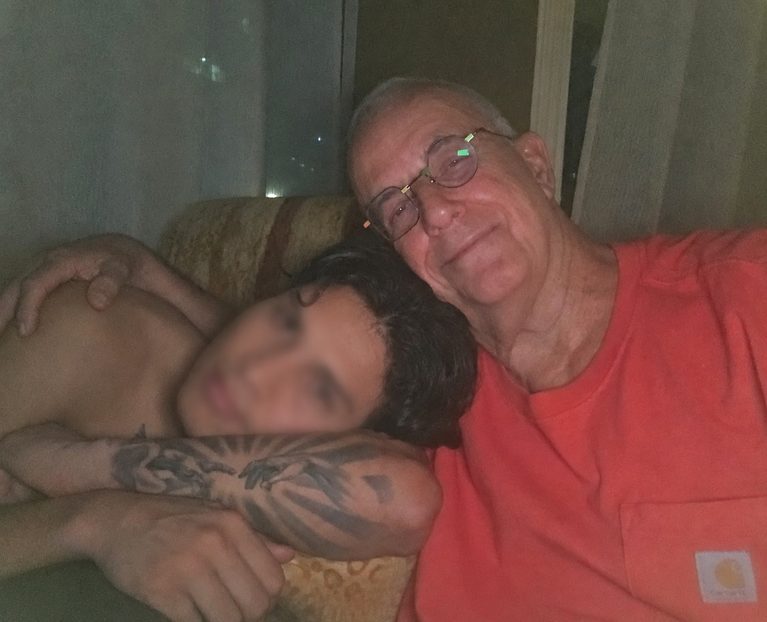
I do remember that the porter on duty that day had a shit-eating grin on his face as he welcomed me home with a fist-bump and his trademark “velly gud” English while I wheeled myself up the parking ramp into the building. Jackson and Michael hovered to the point of obstructing me as I entered the elevator to our apartment. I sat down at the dining room table. Jackson stayed a while to make sure that we had what we needed and then left. Suddenly it was just Mikey and me alone together again. At home.
I went to rest in my bed fairly quickly. That was when I started discovering what the ablation had actually done.
For weeks, if not months, getting into and out of bed had been a negotiation with pain. Changing positions from lying to sitting hurt. Sitting to standing hurt. Standing to walking hurt. My body had been trained to brace itself for pain before I even moved. Now I would swing myself upright to sit on the edge of the bed and wait for the pain. Nothing. I would stand up. Nothing. Walk. Nothing.
It took several daily repetitions of this major change in the landscape of my life before I believed it, let alone trusted it. Every time I moved I had the same reaction: What the fuck? My body was still guarding against something that was no longer threatening it.
The absence was loud.
I know that may not make sense. Pain screaming through one’s body is obviously louder than the absence of pain. But after months of anticipating it, the silence was also shocking.
Walking was another matter
I could get out of bed. I could walk to the living room. I could sit at my computer again. I could go out to the balcony. Without pain. Those were things that I had missed terribly.
But I couldn’t do much more. My muscles had melted away. Weeks of compensation and immobility had taken their toll.
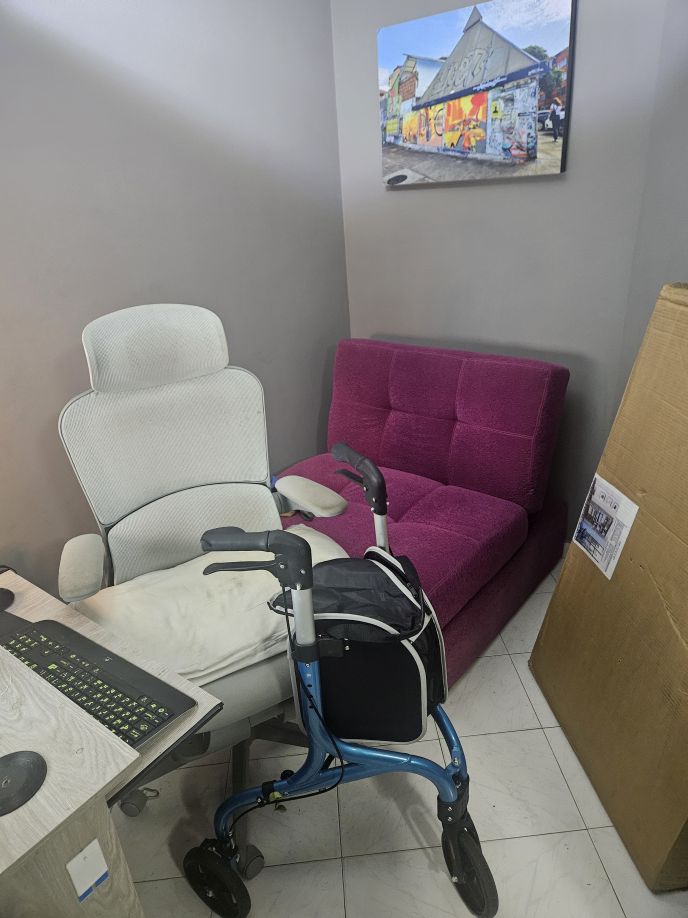
The walker was still part of my life, but it was losing its label as essential. At first I needed it. I don’t remember exactly when I stopped leaning over it to shift my weight from my hips and legs to my upper body the way I had before the hospital and began standing upright again. Within days I started walking without it inside the apartment. It wasn’t pretty. I walked like Herman Munster: awkward and stilted. But it was walking.
I resumed physical therapy with Cleo. At first she mostly massaged me, poked and prodded, and tested things, trying to identify what was still working and what wasn’t. If I exercised at all that first visit, it wasn’t much.
Then came the baby exercises: sitting down and standing up, tightening my abdomen and glutes—my core—working with a ball, squeezing, side-stepping with a resistance band around my ankles—what I called my crab walk—trying to rebuild the muscles around the hips and pelvis that had apparently forgotten their jobs.
I can blame the muscle weakness for my neglect, but the truth is that I wasn’t very disciplined. Cleo would come every few days, but between visits I wasn’t doing what I was supposed to do. I could tell that she was disappointed in me. I was disappointed in me. Eventually I told her not to come back for a while. If I wasn’t going to do the exercises when she wasn’t there, I was wasting her time and mine.
Part of the problem was discouragement. I couldn’t help comparing my expectations for this recovery with the steroid block that I had received in February and coming up short. That time, within days I was walking around Bogotá—airports, city streets, blocks and blocks at a time. This time the pain was gone, but I wasn’t back. The rebound just wasn’t the same.
That pattern was not new. Every major intervention that I have had in my life—hip replacement, spinal fusion and plenty of things less dramatic—produced a rebound. Sometimes the improvement was enormous. But like a bouncing ball, each rebound seemed to come back a little lower than the one before it. Maybe that is simply one definition of aging: the laws of physics eventually win. Whatever the explanation, something gets lost with each miracle surgery.
There is another distinction that matters to me. Since the spinal fusion, nothing that has been done has reversed the underlying degeneration in my spine. The anatomy keeps changing, and not in a good way. Disks bulge. Bone changes. Spaces narrow. Injections, medications, blocks and ablations can reduce inflammation, interrupt pain pathways or stop particular nerves from carrying the message to my brain. But these medical tricks do not rebuild the deteriorating machinery underneath. Relief can be real without the underlying cause being repaired or replaced.
Recovery was not restoration.
Still, things slowly improved. I was walking around the apartment more often without the walker. A few times I would go to bed and realize the next morning that the walker was at the other end of the apartment because I had simply forgotten that I might need it the next morning. I began going down to the lobby to collect packages from the porter. Eventually I walked outside, a block or so to my favorite panadería for a loaf of sourdough bread.
I started cooking again, sitting on a bar-height wheeled chair in the kitchen. Though preparing a meal could leave me exhausted, being able to cook felt like another part of ordinary life returning.
I began taking some showers standing up instead of automatically sitting on the shower stool. Not every time. Sometimes I still wanted to sit there and let the hot water pour over my back, especially after I discovered that the showerhead heater had another setting: hot. Really hot. Full-pressure hot water. But now that was an act of indulgence, not necessity.
Javi and Suly came over and helped us with projects around the apartment: cleaning the bathrooms, reattaching a curtain rod that had lost its grip, finally replacing a kitchen-drawer bottom that had been disintegrating and creating a disgusting mess, and installing a raised toilet seat with a bidet—another Hallelujah moment. Little pieces of my ordinary life were returning, along with a new exotic tweak or two to our nest.
My mood was improving. I started doing my PT exercises again, almost every day for about a week. I was thinking that it was time to call Cleo back because the starter exercises were no longer enough. I wanted her to help me take it up another notch to improve my strength and flexibility. For the first time since leaving the hospital, I could see and feel progress.
Then one morning I tried to get out of bed.
The pain came back
It was July 30. I know because I document nearly everything these days. I sat up as usual and was completely caught off guard by a sharp pain on my right side. It felt like my hip, but by now I was becoming an expert on referred pain. Then a hot, searing pain shot down my leg, into my calf, even into my foot, although the foot was already so swollen that it was hard to know what belonged to what.
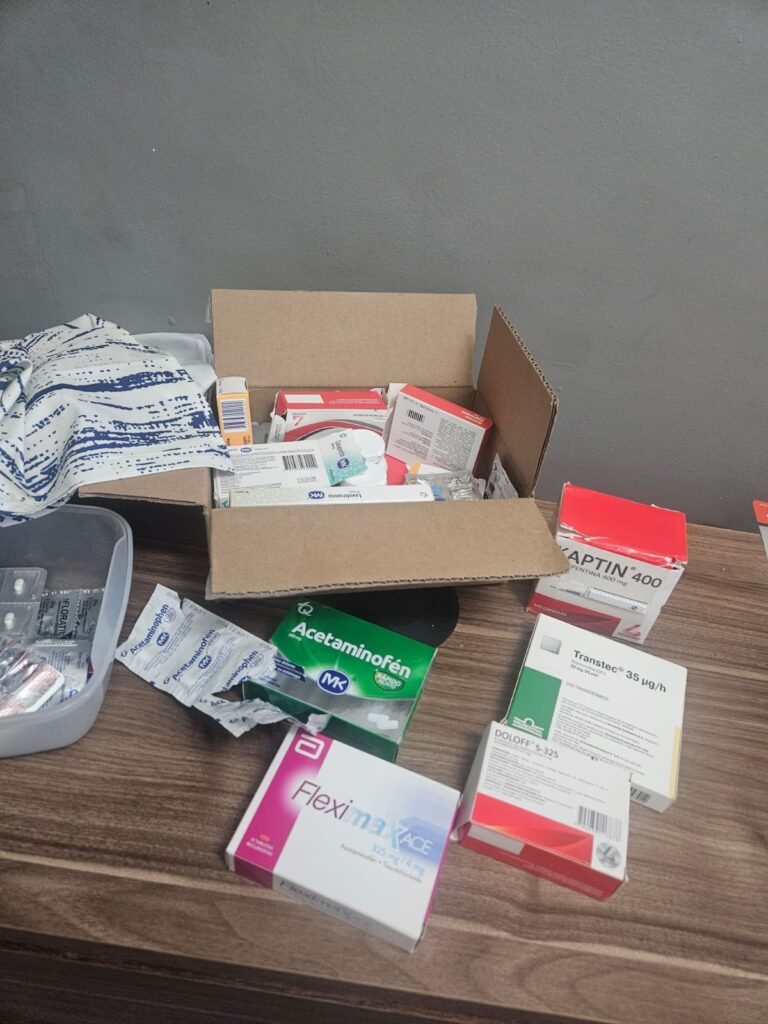
Only the narcotic patches required proof of a prescription to purchase
and have delivered to our door, usually within minutes.
The Doloff contains hydrocodone, one of the most effective pain drugs I’ve used.
It is also the reason that I can barely keep my eyes open after 8 hours of sleep.
It was just shy of four weeks after the “successful” ablation procedure, enough time that I had largely deprogrammed myself from anticipating pain in that exact area of my body. Despite the timing, my first reaction was almost reassuring: This is different. This is sciatica. This isn’t the pain they treated. I convinced myself that this had to be a new nerve, a new problem, something unrelated to the pain that had been attributed to my sacroiliac joint and had put me in the hospital.
I had been reprogramming myself to accept new limitations after the procedure and discharge. I could tolerate the muscle weakness. I could tolerate walking like Herman Munster. I could adapt to no more hiking in the Bosque. I would just forego splashing around in rivers, exploring for waterfalls and chasing rainbows. I could live with a diminished body. Hell, I could learn to live in a wheelchair if need be, I told myself.
I had just wanted the pain gone.
And suddenly it wasn’t.
I froze in place, hoping that the pain would resolve itself. Sitting on my butt on the edge of the bed hurt like hell. I considered lying back down, but the moment I shifted my body in that direction I could tell that it was going to make things worse, so I chose to stand instead. The pain may have changed a little, but it didn’t disappear.
Then I tried to step toward the bathroom. As soon as I put weight on my right leg, it gave out. This wasn’t just pain. My leg had stopped doing what I told it to do.
The walker was there to catch me. Thank gawd.
For weeks the walker had been becoming little more than a familiar security blanket, something that I pushed ahead of me rather than leaned on. Now I was hanging my weight on it again.
I took a Doloff, 5 milligrams of hydrocodone with acetaminophen, the rescue medicine that I hadn’t needed since the ablation. I knew the drill. Wait fifteen minutes. The pain will get better.
And it did. Not gone. Bearable.
The next morning it happened again, and then again. Within days, things that I had started to put away began returning to their old places: the walker beside the bed every night, the urinal within reach, hydrocodone before attempting the morning transition.
My body had spent more than three weeks deprogramming, learning that it no longer needed to be afraid of movement. Now I was teaching it fear again.
At first I kept insisting to myself and others that this was a different pain. Then I began listening to myself describe it: sharp pain in the right hip, moving down the leg, pain when I put weight on the right side.
I had to admit that I had used many of those same words months earlier, before the walker became mandatory, before the urinal was there to save the new mattress, before I ended up paralyzed by pain, face down in bed and unable to move, before the ambulance.
That was when the question changed. It was no longer, What is this new pain? It was, Have I been here before? And if I had, how much time did I have before I ended up in the same place again?
I have an appointment tomorrow afternoon with Dr. Maria at Painfree to discuss all that has happened since my hospital discharge. I was going to wait until after that appointment to publish this episode of my Gran Series. But why? There is never an answer that isn’t accompanied by new questions. New referrals. More tests. Another procedure. This story has no end in sight.
Everybody else has a life
My health was not the only part of our life that was suddenly changing. Again.
About ten days after I came home from the hospital, Jackson came over to join us for a gringo breakfast. I had sensed for some time that there was something important on his mind, and I had sent him a message asking him to come over and tell me what it was. He didn’t argue and he didn’t ask questions about the invitation, which felt a little foreboding to me.
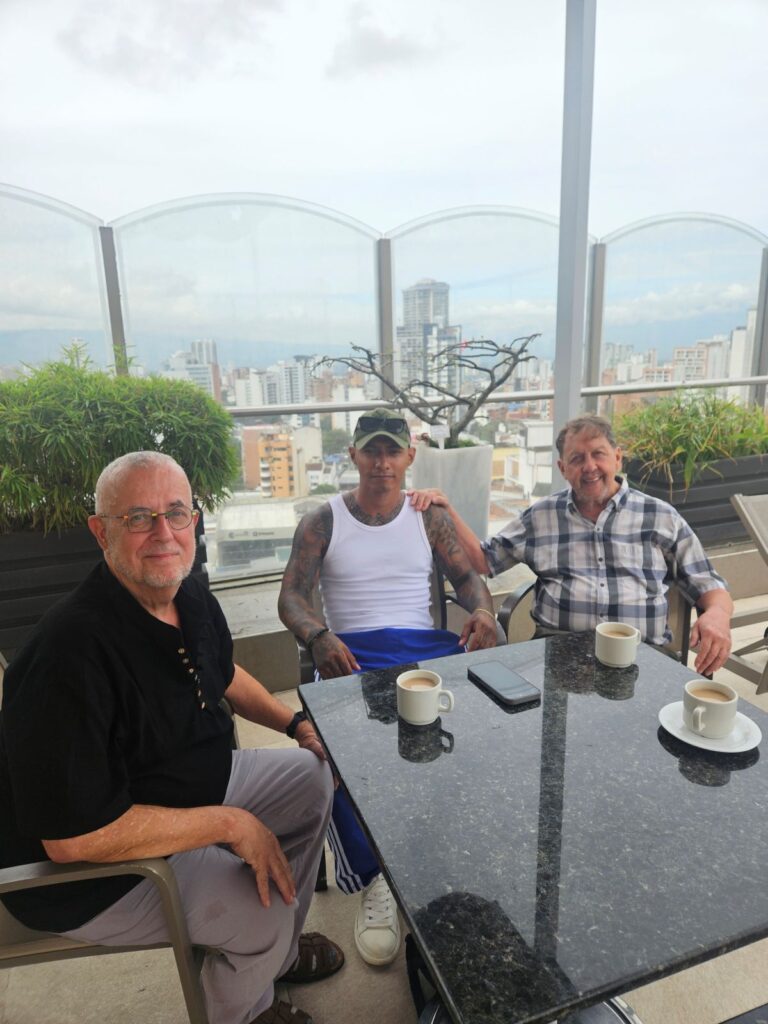
three blocks from our apartment.
He sat down at the dining room table. Michael was nearby, but deliberately giving us some space, something that he has been practicing more and more lately out of respect for my hearing challenges. He knows that I struggle in interactions of more than two people.
“I’m moving,” Jackson told me.
Okay. He had been wanting to move to the United States or Canada or somewhere other than Colombia almost since I met him seven or eight years ago.
“I’m moving to Spain.”
That was not okay. Not in my head, anyway. It sounded so… absolute and certain. His body language told me that he was very serious.
I called Michael back. “Michael, come back. You need to hear this too.”
Jackson said it again. Spain.
He wanted to find work, establish himself legally, and eventually create a path for his mother and daughter to join him. I assumed that this was some vague plan for six months from now, or next year.
No. He was leaving in a couple of weeks.
Internally, my reaction was primitive and completely unfair: You can’t leave now. You can’t abandon me. How dare you?
I did not say that, of course, because Jackson was not abandoning us. He was living his life. That is an important distinction that I have had to keep reminding myself of ever since.
Jackson had become much more than somebody who translated Spanish for us. During the hospital crisis he called the ambulance, dealt with intake, argued about prices, talked to doctors, made sure that somebody was with me, and generally made a foreign medical system navigable when neither Michael nor I could manage it ourselves.
It was obvious that we were important to him too. The frequent visits and WhatsApp messages were evidence of a friendship that was anything but casual.
But Jackson was not born to become our caretaker. Neither was Javi. Neither was Suly. Neither was José.
None of these young people ever signed up to become babysitters for a couple of aging and increasingly infirm abuelos from the United States.
We had built something in Colombia that felt like family. It was family. But Michael and I had already learned from biological family that love does not guarantee availability. People can care about you deeply and still not be able to be there when you need them. Chosen family is no different. That does not make the love less real. It does mean that family, biological or chosen, is not automatically failsafe infrastructure.
That distinction has become painfully important.
Jackson’s departure hit Michael especially hard. Jackson had studied psychology for a while, and he and Michael spent a lot of time talking in English while they were doing other things together—smoking weed, running errands, working around the apartment, whatever. I don’t know everything that they talked about. That was probably the point.
Michael needed somebody besides me to talk to.
I am not always the easiest person in the world to talk to. There. I said it.
I can be direct to the point of cruelty. I can scold. I can decide that there is one correct way to coil a cable, boil an egg or mop a floor and then act astonished that the rest of humanity has failed to receive the memo. I increasingly hear my father coming out of my mouth. That should probably scare the shit out of me more than it does. My family will surely understand. I hope.
Michael has learned over 45 years that sometimes the easiest way to deal with me is not to tell me everything. I hate that. I understand it. And I hate that I understand it.
Recently José asked me whether Mikey was depressed.
Why are you asking me that?
Then he forwarded a message that Michael had just sent him. To me, it read like the kind of message that a very sad man sends when he wants somebody to notice just how sad he is.
And I learned about it from José, not Michael.
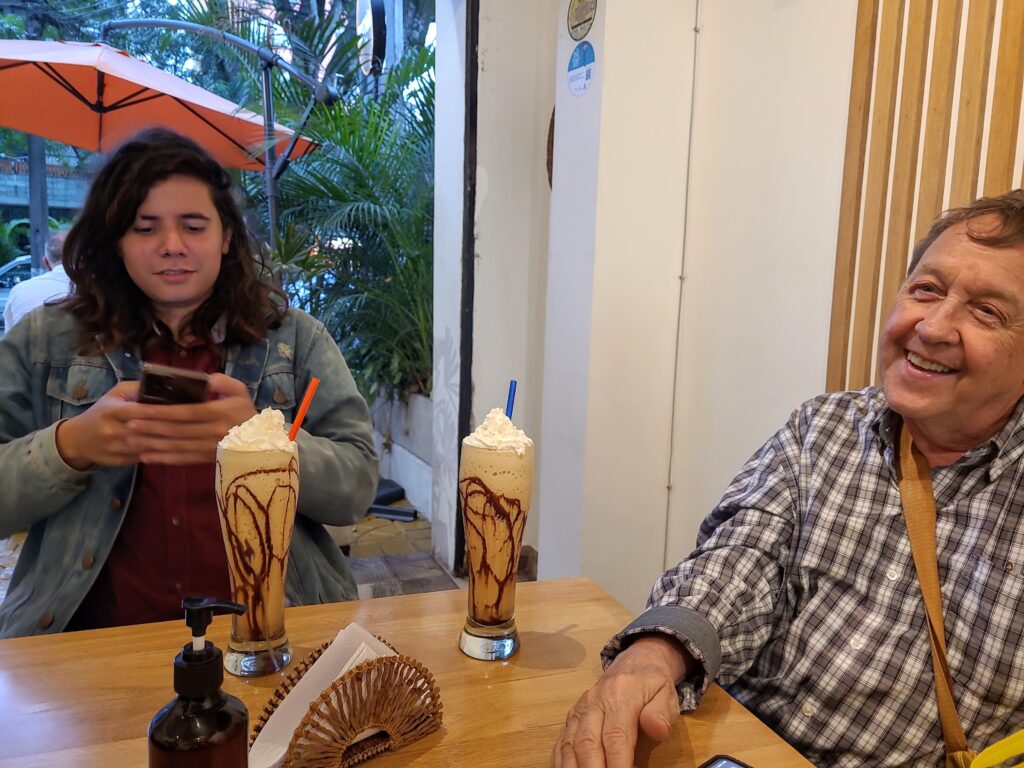
Michael has become the quiet sufferer in this story. No. He has been the quiet sufferer. Now the mask is slipping off.
The hospitalization did not just happen to me. While I was lying in bed being washed, medicated, scanned, blocked and ablated, Michael was aging in front of me. Or was it behind my back?
He is six years older than I am. For most of our lives that age difference was almost a joke. When we were young, he was the one who got carded at bars while I could just walk in unchallenged. Somewhere along the way the blessing reversed. Like the fuel gauge on a car, the last quarter tank goes the fastest.
His vision is worse. His hearing is worse. His energy is lower. His blood pressure is high and his health is not great. The past several months seem to have taken something out of him that I don’t know how to put back.
He still loves Colombia. That matters.
Sometimes I think that people will assume that Michael always hated it here and has been waiting for an excuse to go home. That is not true.
This adventure began as mine.
Michael made it ours.
The people we thought would be there
Javi and Suly are dealing with their own lives, which is precisely what people their age are supposed to be doing. Months ago, they talked sincerely to us about always being part of our family. At one point we even imagined finding a house big enough for all of us to live in, with enough separate space to keep the dogs from eating me and everybody from killing each other.
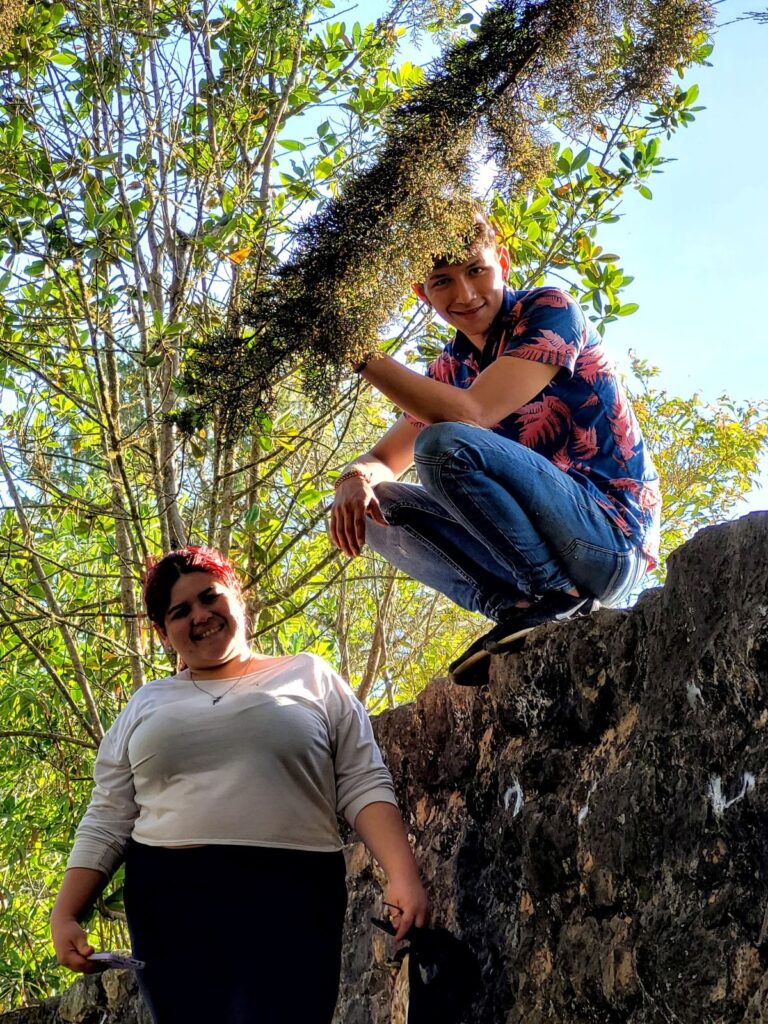
More than anyone else, he and Suly are responsible for us
choosing Bucaramanga as our new home in Colombia.
I believed them when they said it. I think that they believed it too. That doesn’t mean that it was realistic.
Javi has family responsibilities, financial pressures and his own future to figure out. Like almost everyone who is trying to build a life with Colombian pesos, he and Suly have to work a lot of hours. That last part matters.
Friendships here have sometimes cost us money. I don’t mean that in a salacious way, though the thought is fair game. I mean that a lot of our friends here are young, and young people in Colombia are trying to make a living. Sometimes we pay one of them to help us with a project—moving furniture, shopping, going to appointments. Sometimes we buy dinner so that they can join us. Sometimes somebody needs transportation or a few pesos because spending half a day with two old gringos is half a day that they are not earning money somewhere else.
The economics are real and always present.
Recently I had mostly given up on Javi as somebody that we could count on. Not given up on loving him. I had lowered my expectations to a more realistic level. There is a difference.
Then he surprised me.
He asked if he could come over to talk about what was going on with us. He knew that we were talking about leaving. He stayed a couple of hours, which was about all either of us could handle at the moment. I told him that he was trying to absorb in one visit something that Michael and I had been absorbing for weeks.
He kept looking for solutions. What if this happened? What if that happened? What if you could stay? Several times he reached across the table to hold my hand. I’m not sure which of us was getting comforted. Probably both.
Javi wants to save everybody. He wants to be the good son. Sometimes that makes him maddeningly unreliable because he promises pieces of himself to more people than one human being can possibly satisfy.
But that evening he was here. For us.
He was here.
I had not planned on that. Perhaps I should not have been surprised. He is a good boy. I’ve always told him that he is my favorite. He thinks that I’m making a joke. I’m not.
The problem is that he should probably have been somewhere making money instead of sitting with us. He cannot do both at the same time.
Love and availability are not the same thing.
That is another distinction that I apparently had to learn at 70.
Another close friend has moved on too, although “left us” would be unfair. He came to visit and to say goodbye recently. We still have a unique and significant relationship. But he has his family, his plans, perhaps school again, and whatever comes next in his young life. That is what I wanted for him. It still hurts.
José is another story.
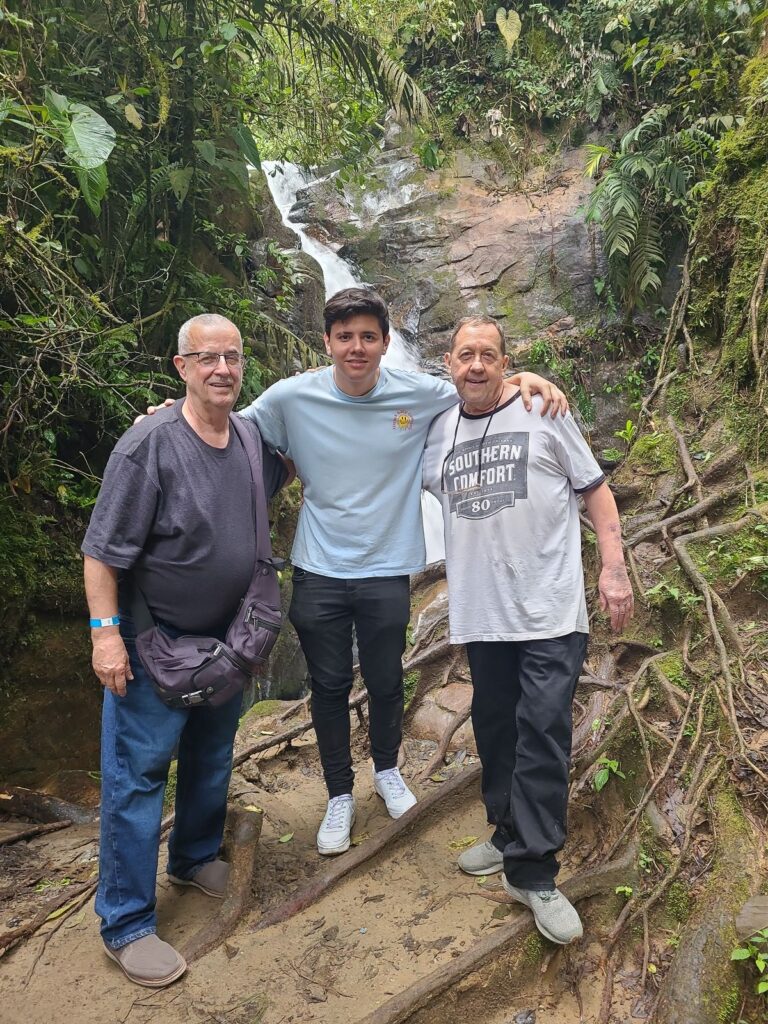
José has been one of our longest Colombian friendships. He joined us for a week in Mexico, early in our hunt for a new home. He has spent weeks with us in other Colombian cities. He has visited here twice very recently. We have talked about him moving in with us, and he loved the idea. Of course he did. José loves almost every idea for at least fifteen minutes.
That makes José sound frivolous, which is unfair. He may be the consummate Colombian entrepreneur. He is always building something, selling something, planning the next business, trying to make the next idea work. He is a talented clothing designer. He works his ass off, sometimes enough that Mikey and I worry that he has forgotten to have a social life.
Now he is planning a trip to the Philippines. With José, even a vacation tends to become another large project with an ambitious goal attached to it. I have learned not to dismiss his plans simply because I cannot imagine them working. What the fuck do I know? I cannot predict the future. None of us can.
José could theoretically live with us. He could help with daily things. He is learning English and he can translate basic messages. He could call 123—Colombia’s version of 911—if one of us were on the floor. He could be another human being in the apartment if something happened.
Meanwhile, even as some people move out of our lives, new ones keep walking in. Daniel. Miguel. Others. I think that the building administration is considering installing revolving doors to accommodate the flow of visitors coming and going to our apartment.
Colombia keeps doing this to us and for us. Doors close and somebody else knocks.
That is part of what I mean when I talk about the magical reality of this country. Not magical realism. I’ll let Gabriel García Márquez take care of that.
I mean the strange conviction that Colombia has given me that whenever something becomes impossible, some unexpected person, workaround, absurdity or coincidence may appear around the next corner.
That is not a reliable retirement plan.
It is still hard to give up.
What if?
Michael and I have spent weeks trying to figure out whether there is any version of our life in which staying here could still work.
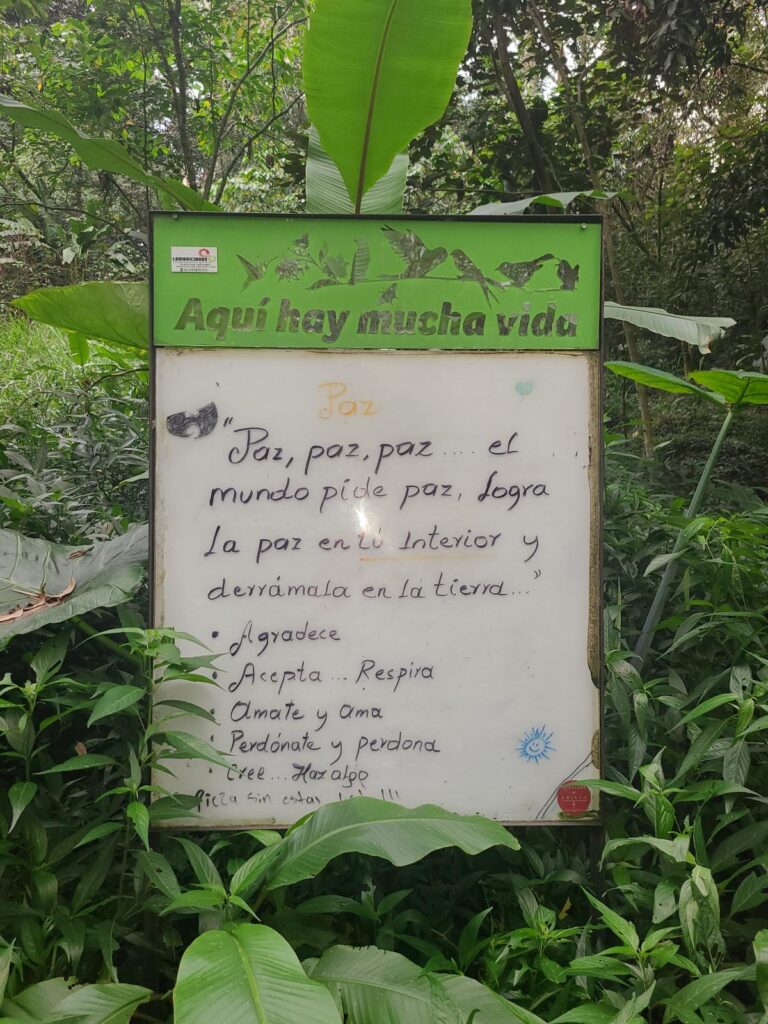
There is a lot of life here.
Peace
“Peace, peace, peace… the world asks for peace.
Find peace within yourself and spread it throughout the earth…”
• Be grateful
• Accept. Breathe.
• Love yourself and love others.
• Forgive yourself and forgive.
• Believe… Do something
Begin without being… (unintelligible)
Recently he went through the possibilities almost like conditions in a contract. If Jon’s pain could be brought back under control. If we could return to something resembling normal life—go to the market, get food, move around the neighborhood. If José could actually move in and help us manage some of the daily tasks. If having another person here would give us enough security that an emergency did not become a catastrophe.
If.
I had asked Javi one of the questions that keeps bothering us: What happens if Michael cannot get me out of bed? He already had to help me sit up this morning. What happens if Michael has a heart attack and ends up on the floor? I cannot pick him up. He cannot pick me up.
Who do we call? Who gets through the locked door? Who explains anything in Spanish?
Javi just nodded. He understood.
Michael said that if enough of those ifs went our way, maybe he would be willing to stay another year. Maybe two. Maybe three.
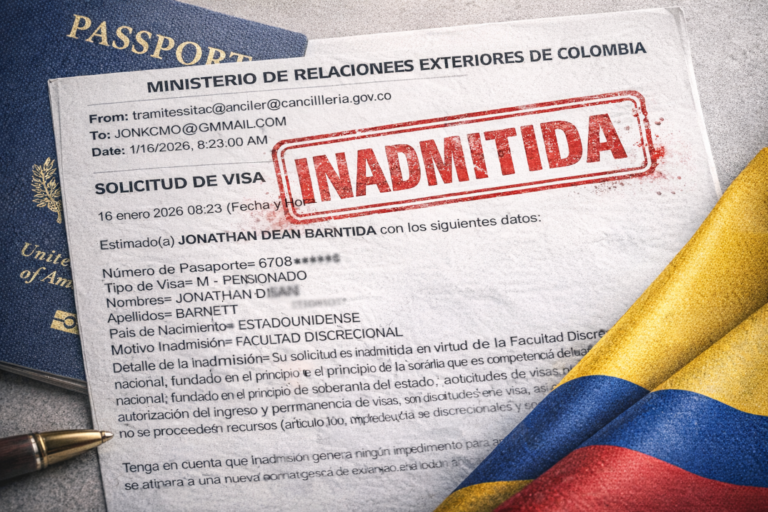
Then we got to the matter of our visas. Our current legal status in Colombia will not last forever. In fact it ends in January. We would have to go through the visa application process for the third time, and we do not yet know whether we would be approved or what requirements would apply when the time comes. Maybe we are being too pessimistic. Maybe we could get another visa without much trouble.
A new visa application is much more than just forms and bureaucracy. It is a financial gamble. So is leaving. There is only one way to find out: apply.
The last round cost us a substantial amount of money by the time everything was finished. Right now, that kind of money matters. A lot.
Our Social Security benefits still give us enough income each month to live reasonably well under ordinary circumstances in Colombia. Ordinary circumstances do not include ten-day hospital stays. Or much medical care at all, even at Colombian prices. Visa applications also take a heavy hit.
The Colombian peso, meanwhile, has been putting on a masterful performance at our expense. Or has the U.S. dollar weakened so much? I mentioned in Part One that our rent had gone up and that the peso was getting stronger. I neglected to do the math. I should have. When we moved here in June 2025, one U.S. dollar averaged about 4,100 pesos. As I write this, it buys about 3,125. A one-million-peso expense that cost us about $243 then costs about $320 now—roughly a third more—before the landlord raises the rent or a doctor sends a bill. Our rent rose too. The exchange-rate squeeze simply sits on top of that increase. Our income arrives in dollars. Most of our life is priced in pesos. You can see the problem.
Our savings—our reserve—have been substantially depleted, thanks in no small part to the “affordable” care available here. Medical costs arrived one scan, one doctor visit, one referral, one medication, one procedure at a time until there was suddenly a hospital stay sitting on top of all of them. Credit-card balances have grown. Each procedure sounds ridiculously affordable compared with its U.S. counterpart. It is the accumulation that shocks the senses and the bank account.
Could we have made our savings go further? Doh. Of course we could have. We don’t feel that much of anything we spent money on was an excessive indulgence at the time. But yes, we are accustomed to living comfortably and, in hindsight, we overspent. It would be disingenuous to pretend otherwise.
Every available option now seems to require money that we also need for another one.
Running out of options turns out to be expensive.
Point of no return
Last September, José was visiting, and I wanted to take him and Michael hiking in the Bosque de los Caminantes—the Forest of Walkers.
I had walked the trail before. It is not Everest. It is a beautifully rugged path through the woods above Bucaramanga, with roots and rocks and hills and a mirador farther in.
That day all three of us were struggling. Michael was older and less fit. José was young but not exactly an athlete outside of the gym. Their panting gave me cover. I could pretend that my own difficulty was normal too.
It wasn’t.
I was trying to ignore the chronic pain in my back, hips and legs, but it just kept squawking louder, trying to get my attention. We stopped. I rested. We continued. We stopped again. Stops and rests are hardly unusual on a hike, but the frequency of these breaks was growing exponentially.
At some point I realized that we were approaching a geographical point of no return. If we kept going, eventually the shortest way out would be to continue to the exit on the far side of the forest. If we turned around now, the shorter route was back the way that we had come, which also happened to be mostly downhill.
I looked at what remained ahead and could no longer deny it. I was quite sure that I could not do it, as much as I hated to admit it.
Fuck. I cannot do this.
We turned around.
My determination and my denial had been defeated by the Bosque. Or that is how I remembered it for the longest time. Now I try to think about it differently.
Turning around did not mean that taking the hike had been a mistake. It meant that conditions had changed. I had reached a point where continuing simply because I wanted to continue would have been stupid.
Today, eleven months later, I mark that as the beginning of the end of mobility as I had known it in Colombia.
The harder question now is whether Michael and I recognized that point soon enough.
I had kept looking for the point of no return as though somebody would put up a sign:
POINT OF NO RETURN — 100 METERS
Life apparently does not do that, though it would have been nice if it had before I turned 70. Or maybe 69. Or maybe it does and I ignored the warning signs. Denial is a cruel partner.
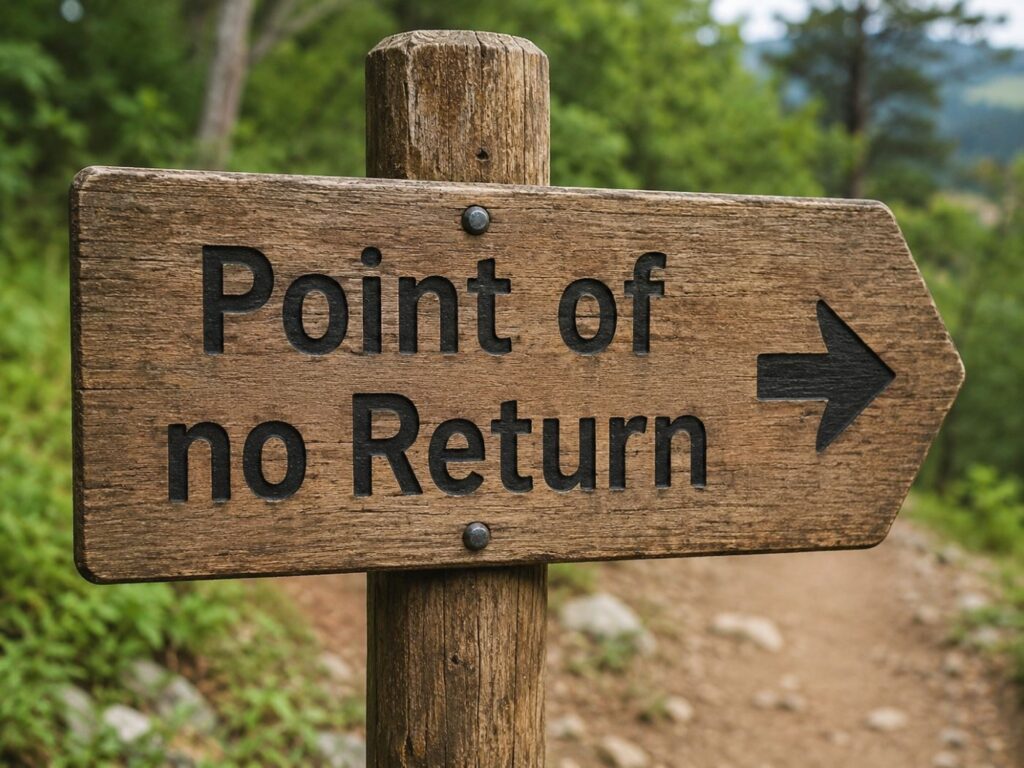
The path just keeps going. You tell yourself that you have time. Maybe the next treatment works. Maybe physical therapy works. Maybe somebody moves in. Maybe our finances improve, or at least stabilize. Maybe I get stronger. Maybe Michael gets stronger. Maybe Jackson changes his mind. Maybe Javi figures out his life. Maybe José comes back from the Philippines having conquered another improbable goal.
Maybe you don’t have to get old to be an old fool.
Maybe.
There is nothing wrong with hope. There is something wrong with making hope try to do the work of a plan.
Did we fail because aging surprised us? I am 70. Michael is 75. What the hell did we think was going to happen? In our defense, we have never been this old before.
Decline itself was not unforeseeable, but were we really expected to be able to predict which vertebra, which artery, which joint, which set of eyes or ears would fail first?
I choose to believe that we did not fail to predict an unpredictable future. In hindsight, we did fail to build enough margin for an entirely predictable one. Others may want to claim that they saw the train wreck coming, but like I said: hindsight.
That failure does not make Colombia a mistake.
I need to say that clearly because I already know what some people will hear: “I told you so.” “You were crazy to move down there.” “What did you expect?”
Maybe nobody will say it. Maybe this is one of those arguments that I am already having with people in my own head. I am good at those too. Almost as good as I am at denialism.
Denial should probably be my middle name. It starts with the same letter.
But I do not regret Colombia.
Not even now.
Colombia itself was changing around us. Politics had helped drive us out of the United States; now, as migrants living inside another country’s democracy, we watched Colombia swing sharply from left to right as Abelardo de la Espriella succeeded Gustavo Petro.
Then yesterday morning, while Mikey and I sat on the balcony during one of our check-ins, the building began to tremble and sway beneath us. A 7.4 earthquake had struck western Colombia. Apparently the election had been powerful enough to shift the tectonic plates. Jajajaja. Maybe it was just an earthquake. But in a country that has taught me to accept magical reality, it was hard not to wonder whether the ground was shifting under more than our chairs. Colombia will keep changing, with or without us.
What I would lose
I am sitting in an apartment that we could never reproduce or sustain on our budget in Kansas City. We have space and a balcony hanging over the street, where I can sit and watch a nonstop parade of human life: people walking, cars, motorcycles, delivery drivers, Ubers, people going to work, coming home from the dentist, carrying groceries, meeting friends, arguing, laughing and dodging traffic.
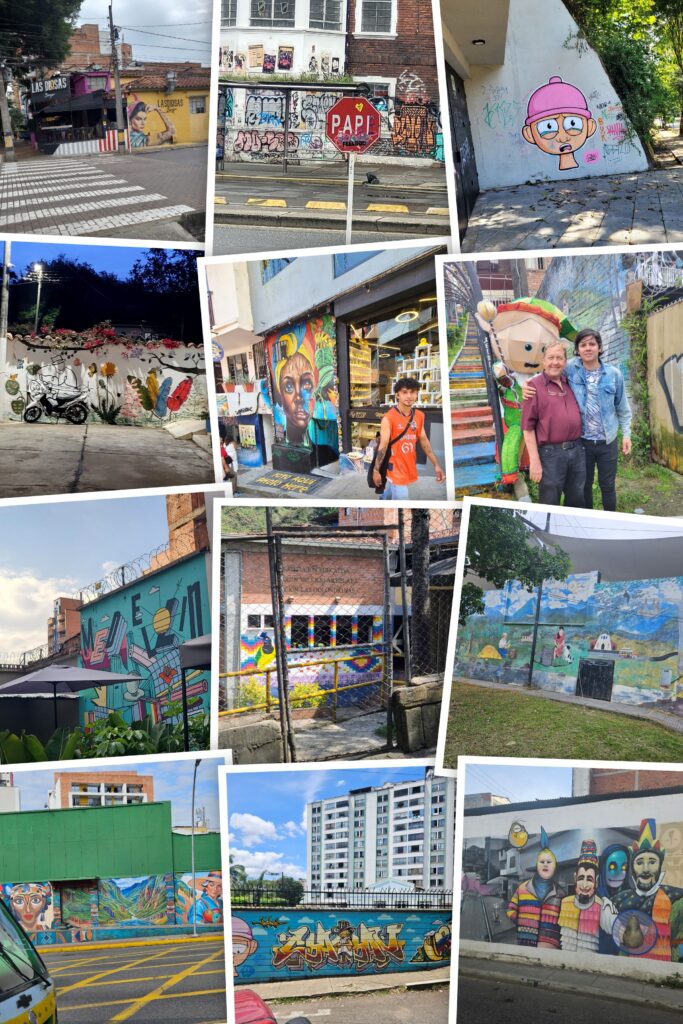
If it gets too noisy, I walk to the back of the apartment or to the alcove where I can sit at my computer and it is quiet. That seems like such a small thing until I imagine losing it.
The weather is nearly perfect. I don’t even own winter clothes anymore. I dress casually, though arguably more fashionably and stylishly than before.
I don’t need a car and I don’t want a car. In Kansas City, living without one will shape almost every decision that we make. Uber exists there too. The difference is that we can afford to use it here, where a typical ride costs about $3, maybe $5 to Piedecuesta seven or eight miles away.
Here, I can need something ridiculous at ten o’clock at night and have it appear at the door. Medication. Groceries. A six-pack of Coke.
Fresh fruits and vegetables do not need a sign announcing that they are fresh. That is assumed. Not everything is perfect by a long shot. We have received bad meat lately, for example. We have had produce delivered that should have been executed before it reached the store. Oh wait. That happens at U.S. grocery stores too. Colombia has not repealed decomposition.
Daily life here is easy in ways that are hard to explain until one imagines trying to replicate it somewhere else.
Then there are the boys. You had to suspect that this was coming.
God, I am going to miss the boys in Colombia.
They can be a nuisance. They cause grief. They cost money. And they help keep us feeling young. They make us feel valuable, not vulnerable. They actually enjoy spending weekend nights playing Yahtzee or dominoes more than I do. They give a whole new meaning to watching a movie on Netflix.
I do not expect to have friendships like these in Kansas City. Maybe I am wrong, but I cannot imagine a steady stream of twenty- and thirty-somethings dropping by our apartment there, sitting at the table, wanting advice, practicing English and teaching Spanish, borrowing things, eating everything in sight, needing money, giving massages, asking for massages, telling us about girlfriends and boyfriends and family catastrophes and whatever crisis occurred in the last four hours.
In Kansas City, our visitors are more likely to be our peers. We can sit around comparing knee replacements and bowel movements.
Call me what you will. I’ll take the boys.
I think that we are going to be lonelier in the United States. I cannot imagine that we could be happier there, ten-day hospital stays excluded.
Maybe we can find an apartment in the River Market or Crossroads, where there is activity outside. The streetcar would help. We will need transit because we do not want the expense and trouble of a car. Besides, as a rule of thumb, two 70-somethings probably should not be buying another car. That’s not ageist. It’s realist.
I can imagine us living in the middle of downtown Kansas City and still being lonely and feeling completely separated from the world.
Right in the middle of town, but totally alone.
Here the city climbs onto our balcony. I can shut the door on it when I want. I am not sure that I can afford that kind of life back in the USA.
There is also the medical contradiction.
If we can get ourselves reconnected to the systems available to us in the United States, I assume that there will be help. If my back pain gets completely out of control, I can go to a hospital. They can put an IV in me and probably control it with powerful pain medication, if nothing else. I will probably have more predictable institutional support.
On the other hand, the United States has become increasingly cautious about opioids, and I remember what pain treatment was like before my hip replacement and spine surgery. Here I can order the hydrocodone that I was prescribed online and have it delivered to my door without ever being asked to show the prescription.
That may not be the best argument for Colombian healthcare reform, but at three in the morning when I cannot stand up, it feels pretty compelling and very appreciated. It beats a trip to the ER.
At the other end of medicine, I worry about control for a different reason. Michael and I have been working on our advance-directive documents here in Colombia. I want choices if medical treatment reaches the point where treatment is merely extending suffering. Colombia’s Constitutional Court has recognized a fundamental right to die with dignity and has opened legal paths to euthanasia and medically assisted suicide under defined conditions. The problem is that there can still be plenty of obstacles between a court ruling and a bedside in this deeply Catholic country. A good death can look much more achievable on paper than in real life.
I worry that the United States medical system may be more determined to keep me alive than I am.
I did not come to Colombia expecting to live forever.
I came here because I wanted to live before I died.
I still want to live.
Leaving
The practical problem is that deciding to leave Colombia and actually leaving Colombia are two very different propositions.
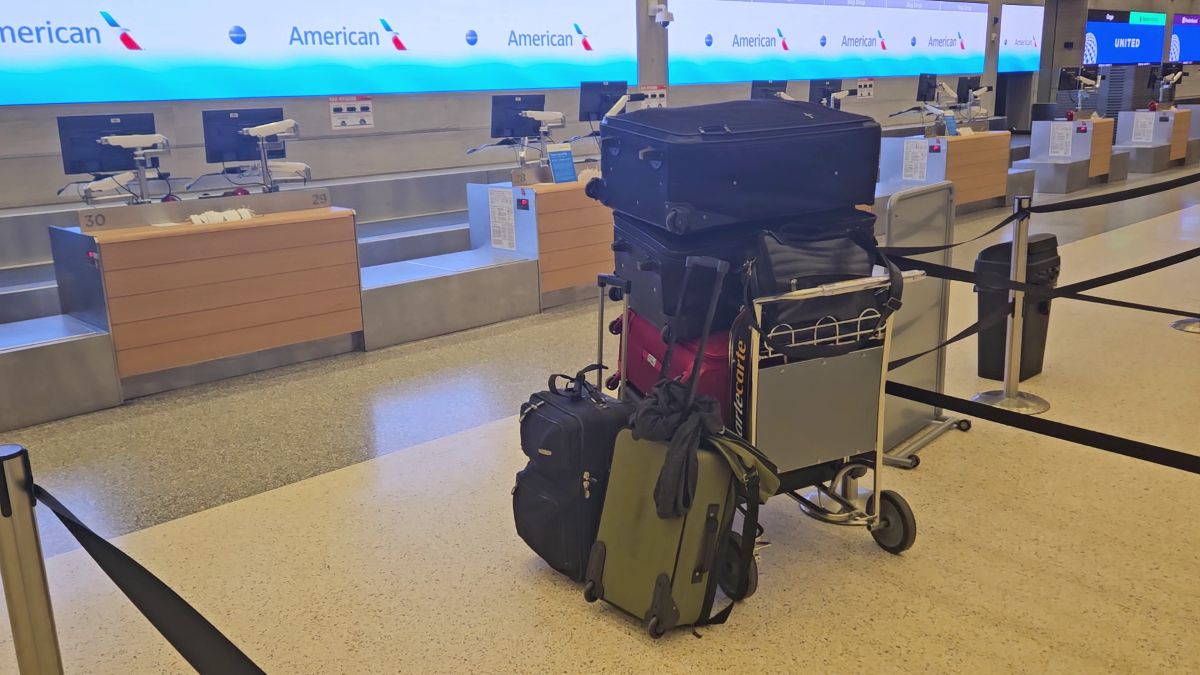
to get to this point in an international move.
The logistics are overwhelming, and I do not use that word lightly. I must use it literally.
We furnished this apartment. We have a huge flat-screen television. We bought living-room furniture that we actually like—three leather swivel chairs and a couch. Five ceiling fans. A dining room table that is frankly kind of a piece of shit but still manages to look good. Kitchen things. Bedroom things. Computer equipment. Photographs. Souvenirs.
Two old men somehow accumulate possessions just as efficiently as we did when we were young.
Some of it we can sell, probably for pennies on the dollar, just like our U.S. moving sale before we came here. Some of it we can leave. The ceiling fans are attached to the ceiling. Don’t worry, Doña Gloria, I am not taking those down.
Oh, yes. We are going to have to talk to our landlady.
From the day that we met, Gloria has been more than just a landlady. We have an unusually friendly rapport with each other. She has been good to us in many ways and frustrating in others. I’m sure that she would say the same of us. We are still waiting for access to that crazy room that we’ve been lusting for, sight unseen. We even gave it a name: the Annex.
In a perfect universe, some of the things that never quite got finished, as well as some of the improvements that we will leave behind, might give us a little leverage in ending our lease early.
I cannot count on it.
She could be generous. She could decide that our furniture and fans are useful if she wants to rent the apartment furnished. Or she could suddenly discover every sentence in the lease and hold us to it.
We are going to need a come-to-Jesus meeting with Doña Gloria, who just happens to be a lawyer.
Utilities have to be closed. Accounts canceled. Subscriptions stopped. Anything attached to a credit card has to be found before it keeps nibbling at us from another continent.
We have a fireproof bag full of important papers that we brought with us. That goes back. Some clothes go. A lot of clothes do not. Ironically, we will likely arrive in Kansas City needing clothes because we own next to nothing suitable for a Kansas City winter.
I have too many shoes. I know. Shocking. Most of them no longer fit my swollen feet.
I want the frameless photographs from our walls. They do not take much space, but they will be awkward to pack and susceptible to damage. We want our personal souvenirs from Colombia, probably more than the few that I brought with us from the United States. There are things here that have become pieces of this life, and I am not ready to abandon all of them just because American Airlines has baggage limits.
Then there is medication. We would need enough to get through the transition until I can reconnect with care and the programs that I used before.
We would need help packing.
That sentence is easy to type. The reality is harder.
This morning I could barely get from the bed to the bathroom. At one point I used the urinal because standing seemed like too much pain and too much risk. If I drop something, it stays on the floor until either Michael picks it up or I can find my grab stick.
How exactly am I going to pack an entire life? Again.
Michael will have to do the lion’s share of the physical labor involved, and he is already running on reserves. That is one of the things that feels most wrong about this. He has spent months taking care of me while his own health and energy have been neglected, and now the reward is that he gets to organize another international move.
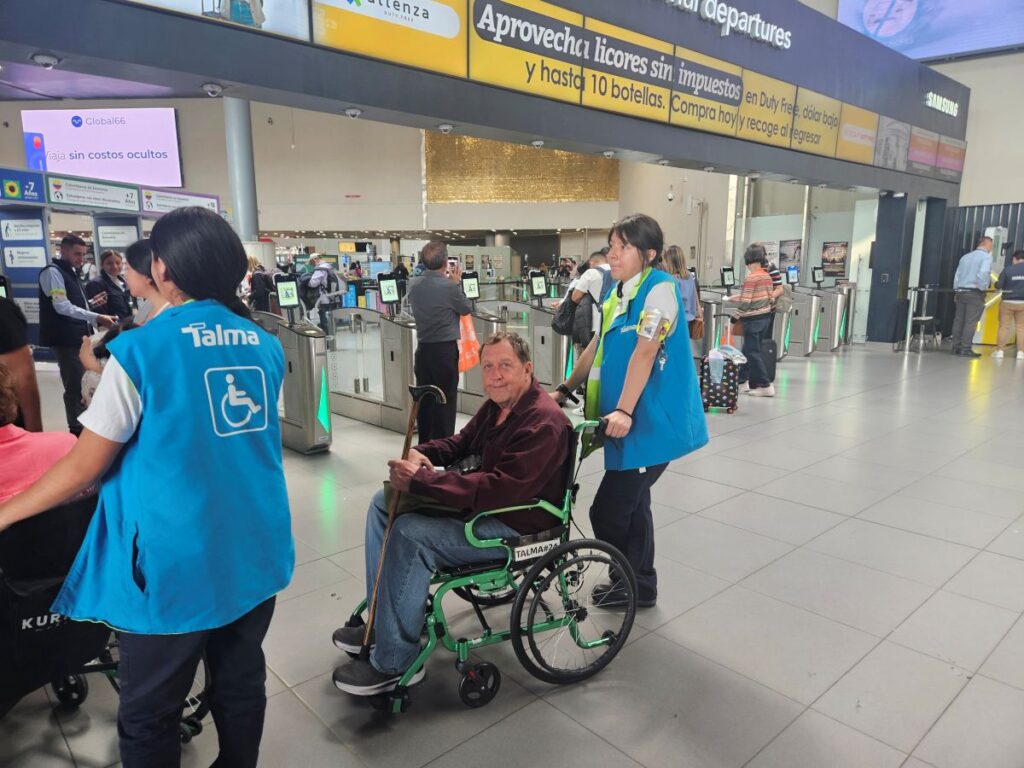
on connecting flights home to the US from Colombia.
Congratulations, honey. Here’s a roll of packing tape.
We will need Javi, Suly, José, Daniel—somebody. Beg them. Pay them. Feed them. Probably all of the above, and don’t forget the Uber to get here and back home.
Then everything has to get downstairs and into transportation, then to the airport and onto a plane. And that does not account for transfers, customs hassles, possible delays and last-minute changes.
At this moment I cannot imagine being able to get out of an airplane seat after sitting in it for four or five hours. Maybe we will need first class. There goes more money.
If we wait too long to book, fares go up. If we book too early and my body collapses before the flight, then what?
Wheelchair assistance will not be optional for either of us. A gurney for me would be nice.
I have even started wondering about that expensive international insurance that I had to purchase to get our visas. I notice there is a clause about emergency medical evacuation, although I do not yet know whether that means anything useful for our situation. I need to find out what “emergency” means and what “medical evacuation” actually covers before I start imagining a private jet arriving in Bucaramanga with a cocktail to take me home.
Then there is that damnable “pre-existing condition” exclusion, a phrase that I thought the Affordable Care Act had largely banished from my life until I started looking at international insurance policies.
Then, assuming that we successfully extract ourselves from Colombia, we land in the United States.
We will need help all over again.
Where do we land?
Kansas City is the logical choice. We lived there for more than 45 years. Our friends are there. Doctors that we know are there. Hospitals that we trust are there. We know which streets go where. It would be difficult, if not impossible, for us to get lost there.
At our age, familiarity has value.
But “Kansas City” is not an address.
We need somewhere to go from the airport. Not eventually. That night.
That would be difficult under normal circumstances. It feels harder when I imagine asking people that we left behind a year ago—while we went searching for our own nirvana—to help us come back.
Then we will need somebody to meet us at the airport and help with luggage. We may need temporary housing, then permanent housing. I’m still looking in my contacts app for “somebody.” Maybe it’s spelled some body?
We need to investigate affordable housing. We will want to be near public transit. The streetcar makes the River Market, downtown, Crossroads and beyond attractive, but that narrows the geography and no doubt raises the rent.
It would be nice to be near the hospital system that we know in the Northland. The streetcar does not solve the Northland.
A car would solve many problems. A car would create even more problems: insurance, maintenance, gas, parking, and that’s after buying the damn thing.
We are going to arrive with depleted savings and high credit-card balances, while leaving behind a country where our Social Security allowed us to afford a comfortable ordinary life. The economics of returning will no doubt be even more astonishing than we can imagine now. Here we are rico. There we will feel impoverished. I’m not exaggerating the difference. Our income may qualify us for some assistance, but I do not yet know how much or what kind.
We will have to furnish an apartment again: beds, chairs, kitchen things. Many of the things that we sell here for pennies become things that we have to buy there for dollars. Donations will be gratefully accepted.
Telling this story matters now in ways that I did not anticipate when I started writing it.
This series began as a memoir, written as much for me as for anyone else. I was afraid that I had lost my writing voice and wanted to find out whether I could recover it amid all the drama of this new life. Now it must also become a way of letting people know what is happening before we need them.
Not a marketing campaign. I cannot bring myself to do that. At least not yet. Doing nothing is not an option either.
There may be friends, family, old acquaintances or people who have simply followed this seemingly ridiculous adventure who can say that they have a room, some furniture, a ride from the airport, knowledge of an apartment, help with an application for assistance, a car that we could borrow while we find our feet again, some financial help, or simply somebody that we should reach out to.
One longtime friend in Kansas City is already the person that we trust with the more formal parts of our lives. She has handled our real estate transactions for years. She holds our powers of attorney and living wills. She is part of the machinery that would have to engage if something happened to either of us. When something happens. She obviously did not know what she was getting into when she agreed to serve in that role.
She may also be the person most able to help us figure out where we land.
I have not yet told her exactly how bad this has become. Partly because telling her will make it even more real for us. Partly because she is not inclined to sugarcoat things.
I hate being scolded.
Jajajaja.
The decision
For weeks I kept saying that we had not decided what we were going to do. That was technically true. It was also my own denial manifesting in all its glory.
I could still construct versions of the future in which Colombia worked for us: pain under control, better mobility, José or somebody else living here, new visas, enough money magically reinflating our bank accounts, good-enough health, enough time.
Enough miracles.
Then last week Michael and I went through it all again. The same conditions. The same questions. And something changed.
Maybe nothing changed except that I finally heard myself.
Miracles happen. I believe that. I always have. Colombia has taught me that better than anywhere else.
But you do not build a plan around a miracle. You dare not wait for one.
My pain has been escalating again for more than ten days. Lately Michael has had to help me sit up in bed once or twice when I could not get myself upright. I had already taken hydrocodone an hour earlier, but it was not enough. Or maybe I was just being impatient. I sat on the edge of the bed and waited for relief. We both cried. Again.
How could I not remember lying face down in the same bed, weeks ago, before the ambulance ride to the hospital, unable to move? I got scared.
The pain today is nowhere near what it was then. That is important.
But ignoring the similarities would be worse than foolish.
A month from now I could be stronger. A month from now I could also be less capable of getting through an airport than I am today.
Why exactly are we waiting until the end of the year? For what? One more nerve block? One more ablation? One more doctor? One more promise of 50 percent? Another visa application? Another person saying that he might be able to move in and help us?
At some point hope becomes delay.
I think that Michael knew before I said it. After 45 years, there are conversations that no longer require complete sentences.
So here it is. For the first time, I think, I am saying it out loud and publicly.
We’re going back.
Nobody knows how hard it is for me to say that. How much I hate typing those words.
Nobody.
I still feel as though I am betraying something: my Dream, Colombia, myself. Maybe the people who believed me when I told them that we had found something here.
Or maybe the Dream was just a fantasy and I was crazy to pursue it?
Maybe I am afraid of walking back into Kansas City with egg on my face and hearing a chorus of “I told you so” that exists mostly in my imagination. Or not. I’ve already heard it once.
Whoever said we get to direct our dreams, anyway?
I do not want to leave Colombia. I never wanted to go back. That has not changed.
What has changed is the calculation. What has changed is reality, the kind that isn’t so magical.
I did not come here to spend the last year, last month or last part of my life in unbearable pain. I did not come here to spend what energy I have left figuring out how to leave. I did not come here to abandon Michael to Fate, whatever that is.
Michael should not have to spend what energy he has left carrying both of us through another crisis because I cannot let go of the Dream.
This is not right. None of it feels right.
But “right” is no longer one of the options.
At the Bosque, I recognized the point of no return while turning around was still the shorter way out. I turned around, not because entering the forest had been a mistake, but because conditions had changed and I still had a choice.
This time I am afraid that we have already walked past that point.
If we have, turning around is no longer the shorter way out. We have to keep moving toward the nearest exit, even if that exit leads somewhere we never wanted to go. For us, barring a miracle, the nearest exit leads back to the United States.
I cannot see the end of this trail on Google Maps. I do not know how long it is, what it will cost, or whether we have enough strength or help to finish it. But I know the direction.
We’re going back.The only question is how.