Running Away to Colombia — Part 4
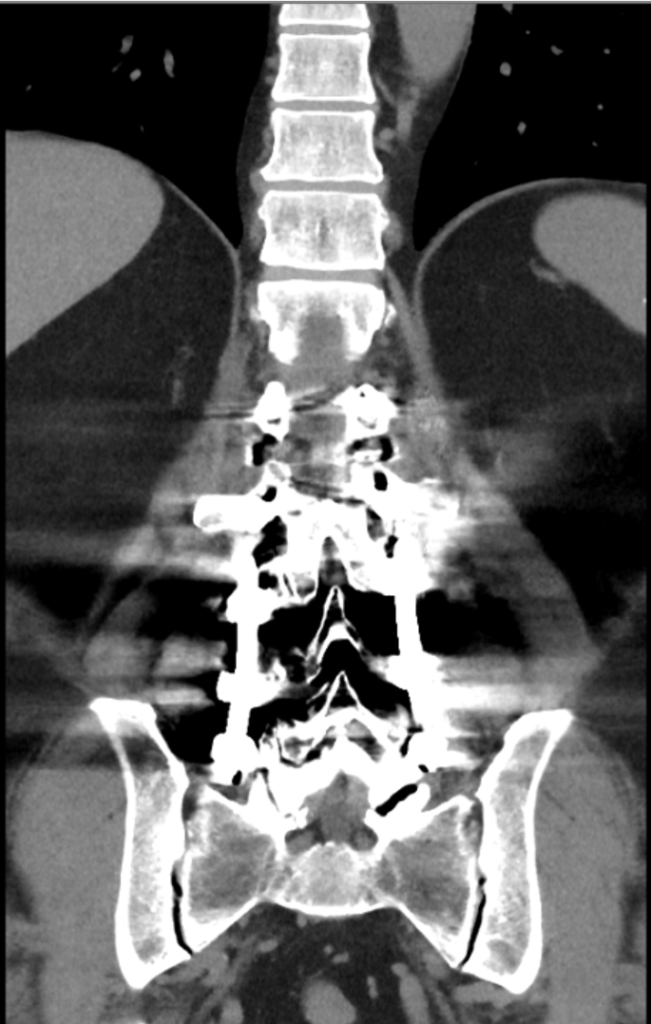
imaging and clarity on this CT scan of my back and pelvis.
I came to Colombia to keep moving.
Before Michael and I moved to Bucaramanga more than a year ago, we had already spent months exploring the country—sometimes together, sometimes with me on my own. I often walked four, six, sometimes eight or ten kilometers a day through barrios and Andean cities. I documented destinations on Google Maps. My fitness tracker kept me honest. I ate better, lost weight, and reported my progress on social media with the enthusiasm of someone who believed he had stumbled onto a cure nobody had prescribed.
Colombia was making me healthier. I had the evidence to prove it.
At least that was the story I told.
I knew there were less romantic explanations. I was more active because everything was new and there was no shortage of sensory stimulation. I was eating differently. Perhaps almost any country might have shaken me out of my inertia.
Still, I believed there was something different about Colombia. Magic may be too easy a word, but I have never found a better one. Colombian friends spoke openly of magical reality, making no effort to explain it away. The country kept surprising me. It led me on. It seduced me with another city, another friendship, another mountain road, another version of my life I had not known was still available.
By the time we moved, the dream felt tested rather than impulsive. I had done my homework—my due diligence. I had asked questions, compared costs, studied neighborhoods, learned about visas and medical care, and tried to imagine what two aging queer men would need to build a life there. The Airbnb we rented for a trial stay became our apartment almost as if it had been handed to us. Javi and Suly felt like family. Jackson moved from Cúcuta and became the person who could make almost any Colombian problem look solvable. Friends visited. New friends appeared. We became social butterflies again. Michael learned to go to the market alone with almost no Spanish, using a pocket translator or his phone.
Colombia began as my adventure, but Michael made it ours. He did that out of a deep and abiding love, even when his trust in the adventure itself was less than total.
I was more comfortable here than Michael was. I felt in my element even when I could not understand what people were saying. Deafness had already trained me for different forms of communication. I was used to reading faces, guessing context, missing half a sentence, transcribing speech so I could read it on a screen, and finding a way through.
Sometimes I would speak enough Spanish to an Uber driver that they assumed I understood the language. Then they would answer at full speed and I would throw up my hands.
“Whoa, whoa, whoa. No entiendo.”
I would flip my bright blue hearing aid out from behind my ear and let it dangle while I explained, casi sordo—I’m almost deaf. Then I might add my well-practiced line that I did not understand German, Chinese, Russian, or English either. My antics, and no doubt my accent, inevitably drew a laugh. We had bonded, even if we needed the pocket translator to continue our visit.
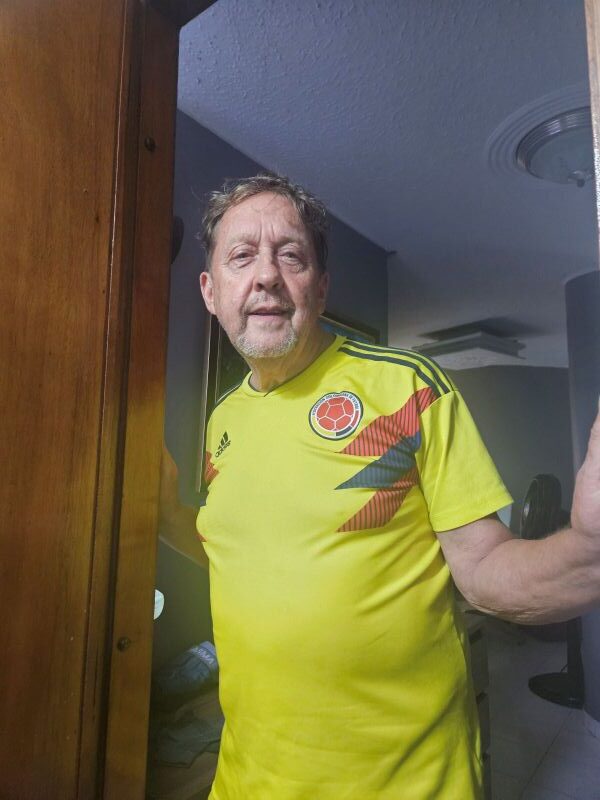
He seems to have had little trouble embracing fútbol and Colombia’s el tricolor.
Michael had no such routine. He had started studying Spanish but was not yet comfortable using it with strangers, though he loved practicing with our Colombian visitors. He came along because we had been a couple for more than forty-five years and because he loved me. He had been with me through innumerable challenges, including serious health threats, and he was not going to lose me over this latest act of madness. There were things about Colombia he genuinely loved, and his confidence was growing, but he would never have chosen this life on his own.
That distinction mattered later, when the person who had helped make Colombia legible for him could no longer even leave the apartment.
• • •
For most of my adult life, I had carried an idea of how my body might eventually fail.
I was diagnosed with HIV in 1998, after living through the worst years of the AIDS epidemic. For a long time, HIV was not merely a chronic medical condition. It was a forecast. People died from opportunistic infections, pneumocystis pneumonia, Kaposi’s sarcoma, and illnesses most of us had never heard of until they began killing our friends. Far too many of our friends. The epidemic devastated our gay social circle the way a hailstorm could wipe out the crops on the western Kansas farm where I grew up.
Even after effective treatment changed the prognosis, those years left an imprint. Somewhere in the back of my mind, I still imagined that the final threat would come from my immune system, my heart, my brain, some other organ failure, a strange infection, or cancer waiting for its opportunity.
I never imagined that the defining struggle of my old age would be with my skeleton.
My body was already partly reconstructed with metal. I had undergone a total hip replacement and major lumbar surgery. A titanium cage permanently fusing five lumbar vertebrae had become a significant part of my spine. A cochlear implant sat inside my skull. I joked with friends that I was biónico.
Years earlier, those interventions had restored abilities that pain had taken away, but they had not taught me confidence in medicine. Medicare and my supplemental insurance had paid the bills, but there were costs that never appeared on a hospital statement. These were not minor procedures. They were major, invasive—even brutal—acts committed against my body. They taught me the cost of restoration: anesthesia, hospitalization, cutting, hardware, weeks of recovery, and the surrender of my body to people who promised the trauma would be worth it.
So when new yet familiar pain began in my pelvis, my response was not, They can fix this.
It was, Oh, fuck. Not again.
I did not want another grand repair or replacement. An epidural spinal block was one thing: a few hours, a needle, and home. Another invasive surgery was something else. I was beginning to draw boundaries around what I would let medicine do to me.
At first, the pain did not require a decision. It could be managed with acetaminophen, rest, or less activity. Once it stopped, I stopped thinking about it. That was one of my oldest habits. If a problem receded, I treated the recession as a solution.
I did not understand how much denial could disguise itself as resilience.
One of the first warnings I could not explain away came in September 2025, about three months after we moved to Bucaramanga, when José visited from Ibagué.
José—No Way José, as we sometimes lovingly called him—was one of the Colombian friends we had known the longest. He had joined us in Mexico in 2022, when we began searching for a new place to live, and quickly became part of our chosen extended family. He remains part of our Colombian life. Michael was especially fond of him. I wanted to show both of them a place I had discovered during an earlier visit: the Bosque de los Caminantes, the Forest of the Walkers.
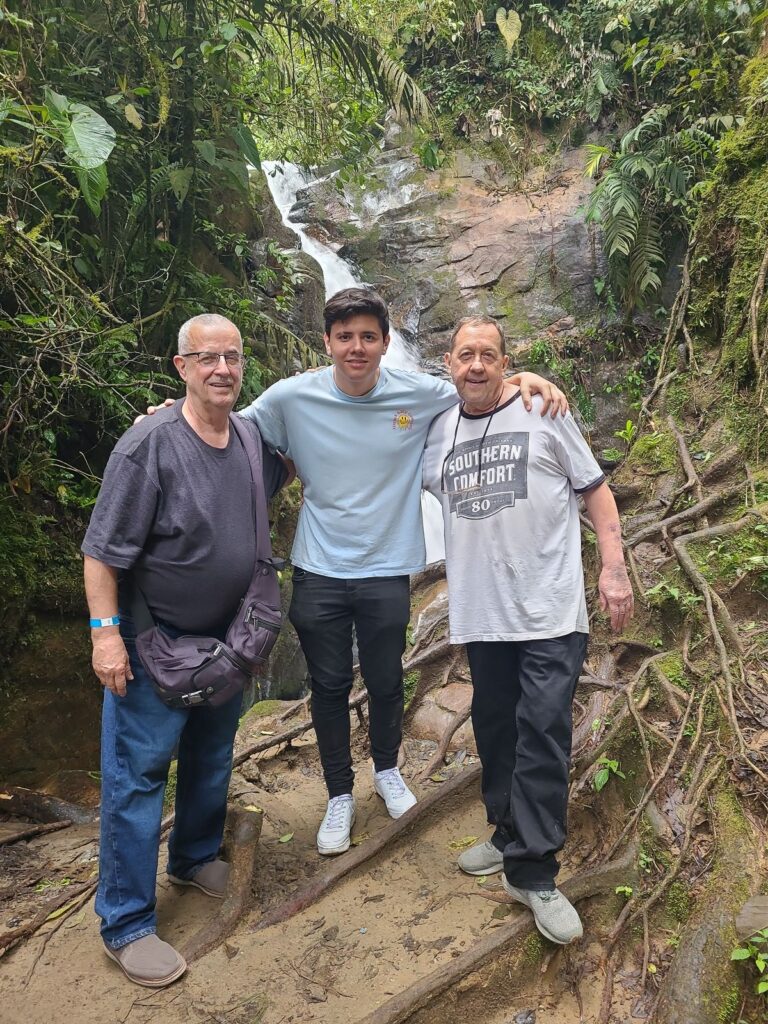
The bosque is part of the wooded mountains along the city’s eastern boundary. Bucaramanga gracefully molds itself around the mountains that embrace it.
The approach was easy. A reasonably smooth, level two-lane road entered the woods and passed a small cluster of houses. A modest sign pointed toward a trailhead with almost no explanation. There was no visitor center, no reassuring map, no ranger telling us what lay ahead. There was simply a path into the trees. Even the typically reliable Google Maps was not prepared to guide us.
I had completed this route the year before with Javi and Suly, so I knew what to expect. It was rugged but manageable: roots, rocks, sharp changes in elevation, and forks marked just well enough to keep us from getting completely lost. Partway through the bosque stood a large abandoned circular platform, perhaps once the base of a water tank, thirty or forty feet across, with a view over the city—a mirador. Nearly three kilometers farther on, the trail eventually emerged back into civilization on the other side of the forest, several blocks from anywhere convenient to call an Uber.
On that earlier walk, a stick had felt like ordinary hiking equipment, not a declaration of disability.
This time all three of us were struggling. Michael was seven years older than I was and not built for vigorous hiking. José was younger but no fitness fanatic. Their panting gave me cover. I could pretend, for a while, that my own stopping was ordinary exertion.
But I was stopping more often.
In a video from the walk, I can hear myself breathing heavily. I remember my heart working too hard. Most of all, I remember the pain in my hips—or what I then called my hips—growing sharper with every rise and every uneven step.
We had not yet reached the mirador. We were perhaps a kilometer from the trailhead when I understood the geography—and the gravity—of the decision. Turning back was still shorter than continuing another kilometer and a half. If I went much farther, the shortest way out would soon be ahead of us, across terrain I was no longer sure I could cross.
I sat down again.
I could push on and hope my body held together long enough to reach the other side. Or I could turn around now and surrender the mirador, the rest of the forest, and the man I believed I still was.
I told Michael and José I could not continue.
Neither argued. They had already seen my struggle and needed no convincing or explanation.
We turned back. By the time we reached the Uber pickup spot, the frequent rest breaks were no longer enough. I could not walk another step.
Nobody discussed the disappointment. There was nothing useful to say. I had attempted a walk I had completed before, in a place I wanted to share with people I loved, and my body had made the decision for all of us.
That was the first time pain issued an instruction I could not ignore.
Either hurt, or stop moving.
After that, the instruction followed me home.
• • •
Walking stopped being something I simply got up and did. Before agreeing to an outing, I began negotiating with myself.
How far?
What kind of pavement?
Would there be somewhere to sit?
How much would I have to carry home?
What price would I pay tomorrow?
Later I would describe the feeling as no longer being the driver of my own body. Pain was sitting in the driver’s seat. And like me, it was deaf to pleas for mercy.
The distances kept contracting. Perhaps a kilometer. Then ten blocks. Then a few. Eventually, walking to the local market and back became an outing, sometimes an ordeal. The decline in my ability to walk was not a straight line. Some days were better than others. If I overextended myself on a bad day, I might need two or three days to recover. A good day could still persuade me that the whole problem had been exaggerated.
Javi and Suly were young, active, and accustomed to inviting us along on evening walks.
“Come on, Papi. Let’s go to Parque San Pío.”
I still wanted to be the person who said yes. I could not bear the disappointment on Javi’s face when I said no.
“Okay. Let’s go.”
We might walk three or four blocks before I had to stop and sit.
“Let me rest a little.”
A break had once been part of a walk. Now the breaks were becoming the walk.
I stopped choosing rugged forest trails, rocky rivers, and waterfalls and began looking for smooth paths in city parks. Elevation became something to avoid whenever possible. A walking stick became two Nordic poles secured around my wrists. They let me transfer a little weight into my upper body, improved my stability, and extended my range—but only temporarily.
Three months after I turned back in the bosque, I ordered a walker.
It was a brilliant blue, three-wheel rollator from Amazon. The color matched my Caribbean-blue hearing aids and cochlear implant and had become something of an accessory color for me. It was lightweight, collapsible, and less bulky than the standard four-wheel walkers I had seen. I could tap a brace with my knee, pull the handles together, and squeeze it through narrow doorways and crowded waiting rooms. It fit easily in the trunk or even the back seat of an Uber.
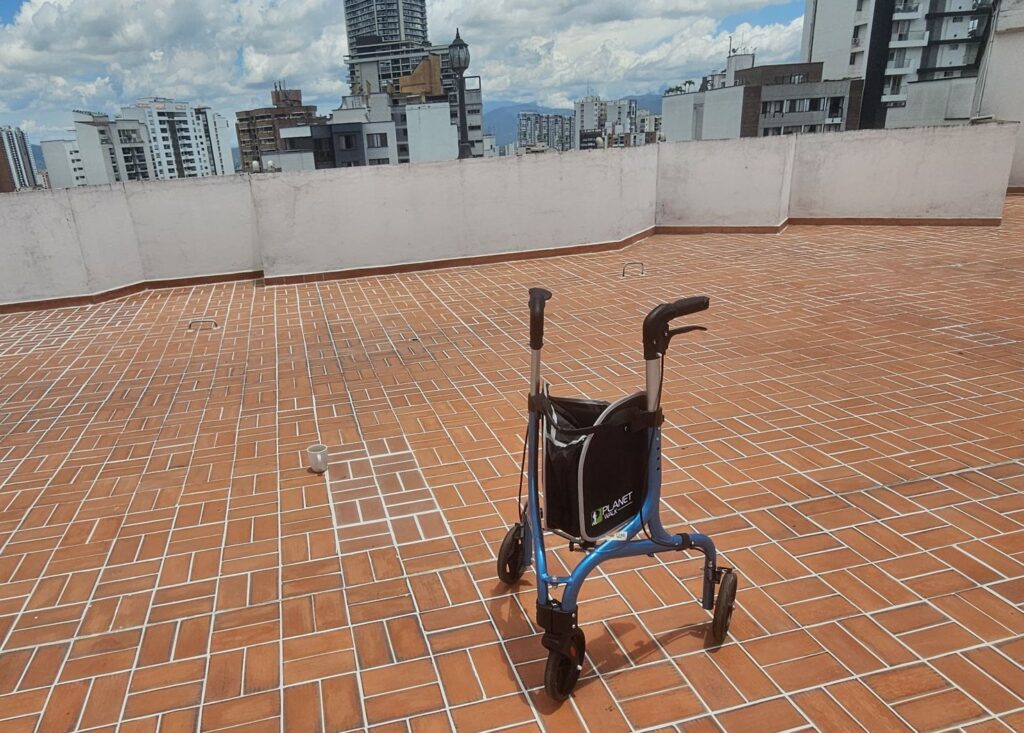
I chose it even though it had no seat. Many rollators allow you to stop, turn around, and sit. Mine had a storage bag instead. I missed the seat almost immediately, although the bag became part of daily life. I used it for groceries, laundry, and clothes I carried from the bedroom to the living room so I could dress where sitting was easier. It often replaced my backpack, reducing the weight on my spine and pelvis.
The difference was immediate. I had not understood how much relief could come from shifting weight away from my hips and into my arms. On smooth floors, the walker was an excellent assistive device for me.
Outdoors was another matter.
Bucaramanga’s sidewalks are full of cracks, holes, abrupt changes in elevation, and improvised repairs. The smallest obstruction could kick the front wheel sideways. With only three wheels, the walker could become a tipping hazard. I never completely lost control, but I learned not to trust it.
I adapted, because adaptation had become my specialty.
The sidewalk on the east side of Carrera 29, the street our apartment sits on, was smoother than the one on the west. I began crossing the street twice just to gain two or three blocks of safer travel on the way to my favored neighborhood mercado.
At first, the walker was optional on these walks.
Eventually, it was not.
As the pain grew progressively worse over the next several months, I began hanging my body on the walker’s handles, stooping over and using my upper body to lift some of my weight away from the part that hurt. A doctor later looked at me and asked why I was using it that way.
I remember looking back as if he had asked why a drowning man was hanging onto a rope.
I knew it was not the prescribed way to use a walker. For me, it was the only honest way to find relief from relentless pain.
At almost the same time, I tried to outsmart the entire problem.
On December 30, I bought a used Segway scooter through Mercado Libre—think of a cross between Amazon and eBay—for three million Colombian pesos, about six hundred dollars at the time. I justified it with the seller’s thirty-six months of interest-free payments.
It was not a toy, although at first that was exactly how it felt. It was a serious two-wheel electric scooter with pneumatic tires, quick and powerful, designed for transportation. I thought I had found the answer to mobility.
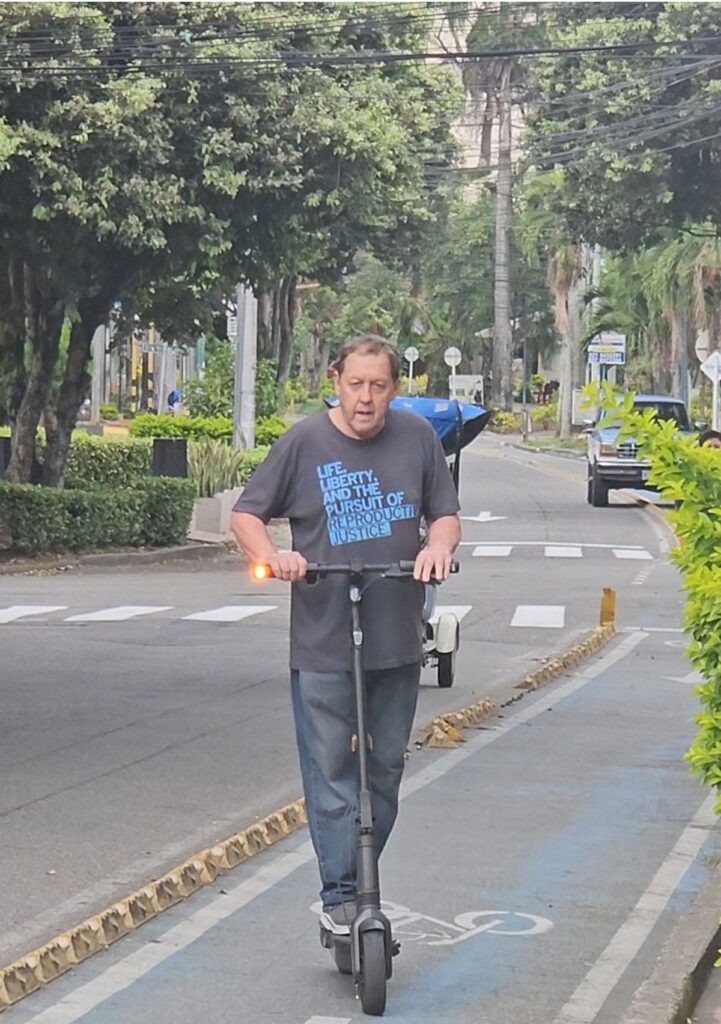
It would have been a perfect mobility option…
if we were both about 30 years younger.
Instead of walking, I could ride.
The first time I used it, it was a blast. I learned within minutes how to stand and balance almost as if I were riding a bicycle. On a Sunday, when the streets were nearly empty, it felt easy.
Ordinary traffic changed everything.
To ride safely, I had to look behind me, monitor cars, react quickly, and turn my head without getting dizzy. My reflexes were no longer fast enough for that environment. My hips still hurt simply from standing and balancing the damned thing. Javi and Suly came over for the maiden voyage, and their concern was hard to ignore. Jackson flatly told me not to ride it on the streets.
One Sunday, I rode to an adjacent neighborhood a little more than two kilometers away. Crossing major streets was a mess, even on a Sunday. On a steep grade, the scooter struggled and I had to get off and push it, irritating my hips. At another point, I carried it up steps to reach a crosswalk because I did not trust myself in traffic.
I did enjoy using it during Ciclovía, when the city closed a major street to cars for walkers, joggers, and bicyclists. The organizers turned a blind eye to the old gringo on a scooter. Riding there felt slightly like cheating the purpose of the event, but I did it anyway. Back home, some local friends and visitors loved riding it. They were young, Colombian, and understood the traffic better than I did.
The scooter had promised freedom. In practice, it required abilities I was already losing.
Eventually I gave it to Jackson.
For a while, though, the walker and scooter coexisted in the apartment like competing versions of my future. One said I needed help. The other said I could still fly through the city.
Both were true.
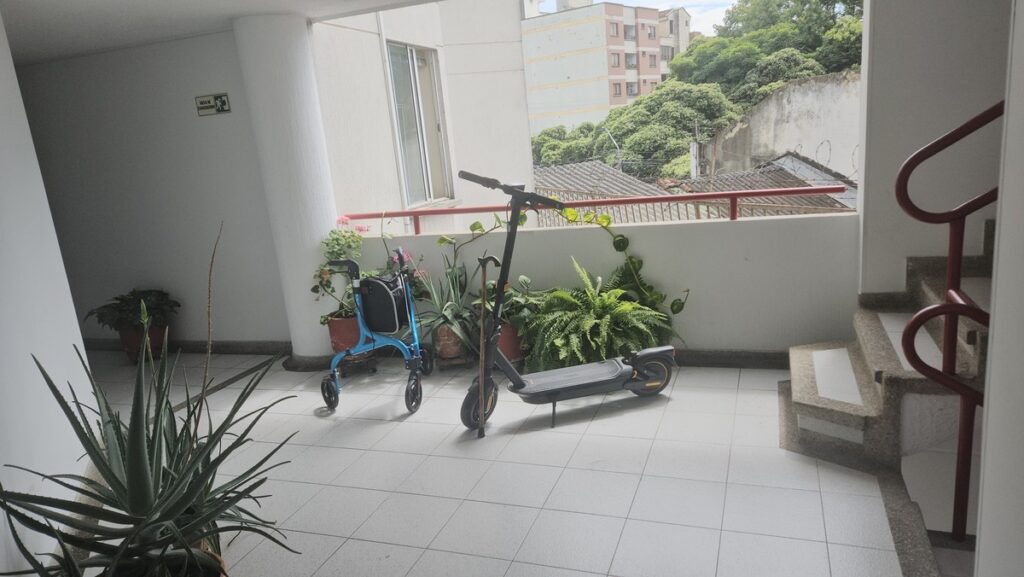
One was fun, the other more useful.
But only one survived the final cut for being allowed
to consume precious space in the apartment.
• • •
Despite my sincere pledge before leaving the United States that I would avoid medical intervention whenever possible, in the final months of 2025 the medical system became another part of the geography I had to navigate.
I went from doctor to doctor, often across the sprawling FOSCAL campus, although I tried to keep visits closer to home. Our neighborhood held a wealth of medical offices, imaging centers, labs, and clinics. Each specialist I saw occupied a niche and almost inevitably referred me to someone else. Everyone was searching for the source of the pain. I felt it in my hips—first the left, then the right—but knew enough about nerve pain to understand that it is often referred, felt somewhere other than its source. One doctor considered the hip. Another considered sciatica. The focus rotated among rehabilitation, medication, the spine, and the hips. The visits were not useless, but they were repetitive, expensive in aggregate, and exhausting.
The FOSCAL campus itself seemed designed as a test for people with mobility issues. Medical offices occupied towers at opposite ends of the huge complex. I repeatedly went to the wrong tower, and the distance between them was too far to manage in pain. Correcting a mistake required an Uber or taxi ride of several blocks.
I had left the United States partly because I wanted to get off the medical merry-go-round. I did not want to spend the rest of my life revolving through appointments, referrals, scans, procedures, and specialists who examined one body part as if the rest belonged to somebody else—all the scans and treatments required merely to rule out one possibility after another.
Colombia gave me a different merry-go-round. Or rather, a similar ride, but with different ponies.
In some respects, care could be more personal here. Doctors made house calls. Appointments and procedures could sometimes be arranged with startling speed for a cash-paying patient like me. The prices were lower. Much lower.
But the rotation was familiar.
Doctor. Scan. Procedure. Relief, maybe. Return of pain.
Doctor. Scan. Procedure.
The plastic horse rose. The plastic horse fell. The scenery repeated.
And every rotation offered hope. That was what kept me aboard.
By early February, I needed more than hope. Michael had long planned to fly back to the United States to house-sit for close friends. In my condition I could not imagine managing the Bucaramanga airport, the flight to Bogotá to help him catch his connection, or even the city itself.
I finally found Dr. Carlos, a spine specialist. We did not immediately warm to each other, perhaps because we were trying to solve different problems. I wanted a familiar epidural block and immediate relief before the trip. He was considering broader treatment options. He proposed platelet-rich plasma, a procedure I knew little about, and scheduled it within days. I prepaid three million pesos, about eight hundred dollars at the time, went home, researched PRP, and changed my mind.
I did not need the most promising long-term idea. I needed the best chance of immediate relief.
I asked his receptionist over WhatsApp whether Dr. Carlos could change the procedure to steroids. He agreed. The price remained the same, which bothered me, but the trip was approaching and immediate relief mattered more than another round of bargaining.
On February 5, I went to the outpatient surgery center with Michael. A team gathered around the now-familiar imaging equipment; this was not my first epidural block. I lay face down while they cleaned and anesthetized my back. Someone gave me a sedative. Then I was waking in recovery.
The block worked.
The relief was as close to immediate as I know how to describe. Some of it may have been the local anesthetic. There may have been a little soreness at the injection site, but what I remember is that by Saturday, I could walk without pain.
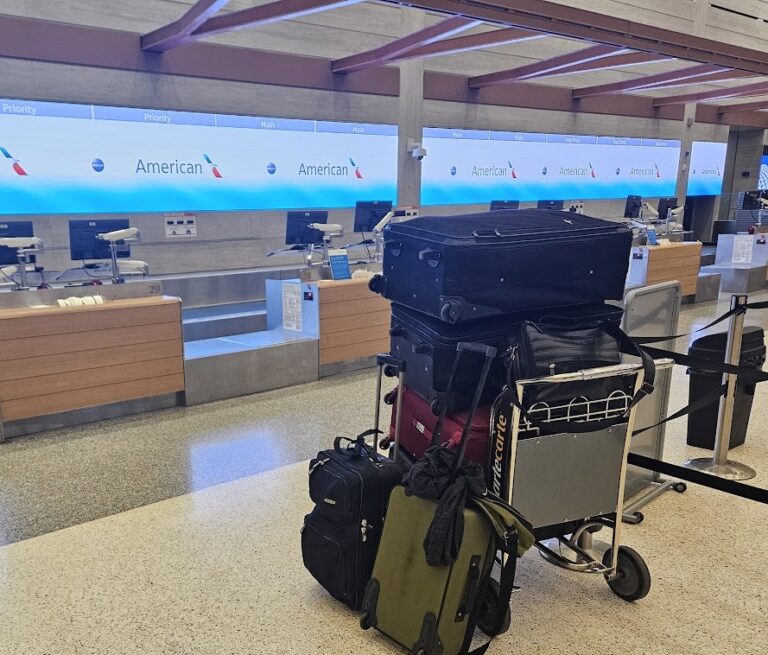
On February 8, Michael and I flew to Bogotá.
I walked through two airports. I walked around Bogotá. My friend Anders joined us the first night, and Michael met him in person for the first time. They hit it off. Then Steven arrived from Pasto, in southern Colombia near the Ecuadorian border. He had once been asked to accompany me across the border for a visa stamp I thought I needed. Thankfully, that trip became unnecessary, so instead I treated him to his first visit to Bogotá.
In Plaza de Bolívar, something in me gave way.
Plans in Colombia rarely disappeared completely. They changed shape.
Thanks to the steroidal epidural block just days earlier,
all I needed to walk in Bogota in February 2026 was my stick.
By the time we entered the plaza, we had walked dozens of narrow, crowded, ancient blocks full of memories of Colombia’s earliest times. I was suddenly and unexpectedly overwhelmed. The square, arguably the most significant historical destination in Colombia, held government buildings, pigeons, vendors, tourists, beauty, history, violence, and the ordinary motion of a capital city. Nothing supernatural occurred. No voice spoke. No sign appeared.
But the energy of the place moved through me and stopped me where I stood.
Before the epidural block, my world had been shrinking toward the dimensions of my pain. In Bogotá, free of pain again, it expanded all at once.
I sat in the square and felt Colombia around me: the country that had seduced me, the country I had chosen, the country in which I still believed Michael and I were building a permanent life.
Michael flew to the United States on February 10. Steven and I remained in Bogotá another day or two, then took a bus back to Bucaramanga. He stayed with me for several more days while exploring a second Colombian city for the first time. Encounters like these, with young Colombian men I had come to know, often defied explanation. I learned simply to accept and cherish them.
During those weeks, I did not merely endure life. I participated in it. After Steven left, a longtime Colombian friend began spending days with me rather than hours. We talked about things we had never discussed before, and something between us deepened in ways neither of us expected. It remains one of the most unexpected relationships of my life—not because I was seventy, although that mattered, but because it reminded me that pain had not yet succeeded in making me stop living.
Architecture replaced anatomy. Streets replaced symptoms. I could look at the city instead of searching for the next chair.
The block gave me about seven weeks.
Only later did I notice the symmetry of the dates. Michael had left Colombia five days after the procedure and originally planned to return in April. He came home early, on March 25. Seven weeks after February 5 was March 26.
Perhaps the injection was simply wearing off. Perhaps Michael’s return became the landmark by which I remembered it. Stress can turn up the volume of pain without inventing it. I cannot prove a connection, and I cannot entirely dismiss one.
What I know is that the relief was real.
The mistake was believing that real meant permanent.
• • •
When the pain returned, it already knew the route.
At first, I could blame a bad day, too much walking, poor sleep, or something I had lifted. Then I could blame a bad week. Soon I was looking for another steroid block.
Dr. JaiCarlos quoted the same three-million-peso price. By then I had found a clinic called Painfree, only a few blocks from home, where an epidural injection cost a fraction as much and the clinic’s treatment philosophy felt closer to my own. I wanted to manage pain without another surgery.
Painfree repeated an epidural block in April. It reduced the pain by about half for only three days. A later nerve block in a different location did not solve the problem either. Those well-intentioned attempts also created a new obstacle: I could not receive additional steroid injections for three months. Patches, gabapentin, hydrocodone, scans, nerve studies, and more opinions joined the rotation instead.
Medicine itself began changing its posture. The question was no longer simply, Which part is injured and how do we fix it? It became, How do we interrupt the signal?
The doctors might not be able to put out the fire. They might only disconnect the alarm while the house—my spine—continued to deteriorate.
Silencing the messenger was not nothing. An alarm like pain can make life unlivable. But it marked another change in the dream. I had said I was willing to refuse medical intervention if only I could live the life I wanted. Under duress, that conviction looked more like fantasy. I wanted medicine to identify the problem, repair it with a minimally invasive, affordable procedure, and return me to the life I had chosen. Now the best available answer seemed to be stopping my brain from hearing what my body was saying.
There is a difference between knowing something, understanding it, and accepting it.
Meanwhile, the nest we had built was becoming both refuge and prison.
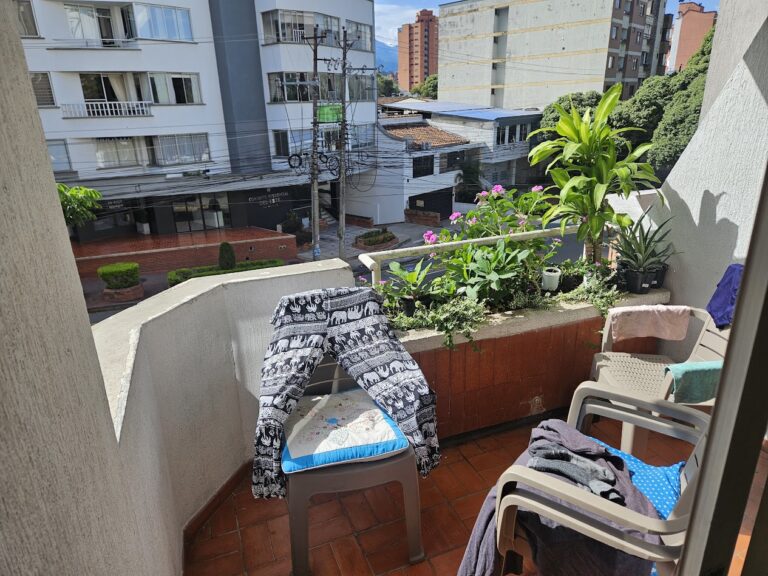
Our apartment is typical of many in Colombia: much longer than it is wide, perhaps three times as deep. At the front are the street-facing balcony, living room, dining area, and kitchen. The front door opens between that living space and a long hallway leading toward the bedrooms.
At the rear, the hallway opens into a small landing outside three bedrooms, the shared bathroom, and the alcove that serves as my office. Only about four feet separate our bedroom and bathroom doorways, but there are no rails and almost nothing to hold. Without the walker, only one piece of furniture along the route offers support.
For years, my mornings had followed a familiar pattern. I often woke before Michael, sometimes at three or four, but more typically around five. I went to the kitchen to make coffee and spent time online while waiting for the sun to rise. When Michael got up, we sat together at the dining table or on the balcony and checked in with each other. It was a daily ritual.
By late May, getting out of bed had become a specific problem.
By June, it had become an event.
Every morning, I woke in crippling pain. Sitting on the edge of the bed sent searing jolts through my hip. Standing sent aftershocks. Finally, I had to hang my upper body over the walker and somehow force myself down the hallway to the living room.
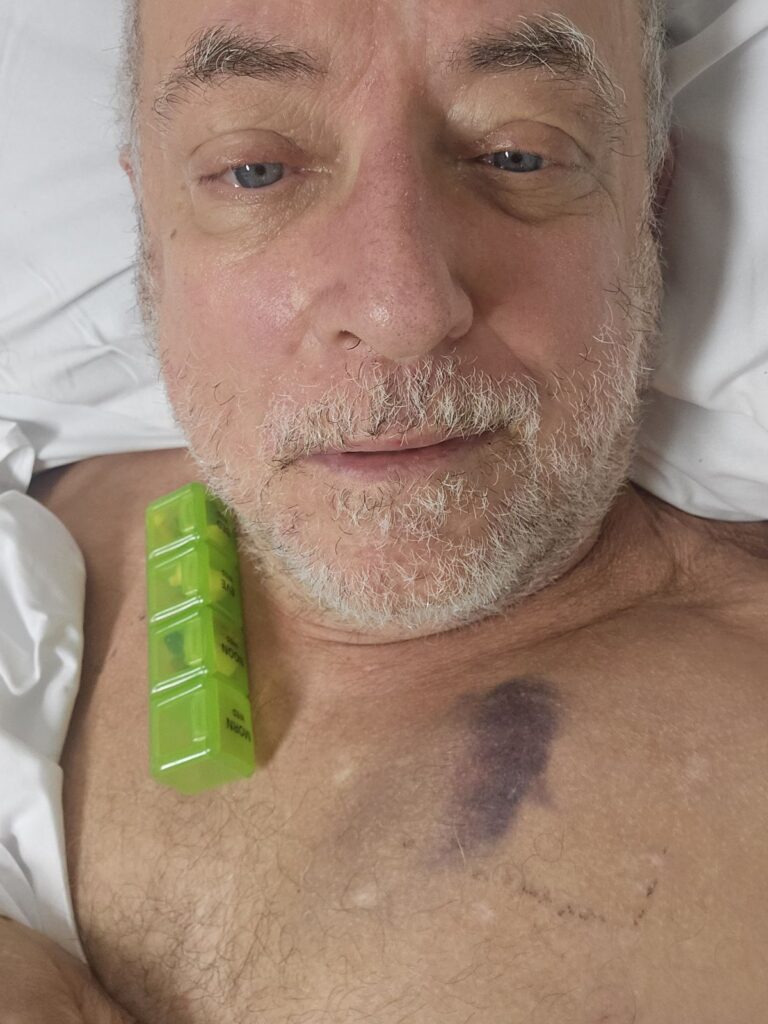
against increasingly unmanagable pain.
There was a large, square, heavily padded armchair there with a pullout footrest. It could unfold into a small cot, but what mattered was the softness of the seat. It was the most comfortable place for my ass when the pain was fierce.
I would take a hydrocodone tablet and sit there crying. Michael had developed an uncanny ability to know when I was getting up, and he sat with me.
I talked to myself.
Jon, you’ve been through this. You know what to expect. It hurts like hell now, but the pain will stop. The hydrocodone will work its magic.
I watched the clock.
I learned that the opioid began to take effect in almost exactly fifteen minutes. The pain did not disappear, but it stopped being horrific. By twenty minutes, I could usually move again.
The transition from agony to relief was profound.
Pain was the main force driving those months, but it did not work alone. The drugs I took to suppress it became accomplices. Hydrocodone could make movement possible, but it also brought drowsiness, constipation, urinary trouble, and mental fog. Gabapentin might help, then put me to sleep for much of the day.
Relief was not the same as recovery. Sometimes it meant I hurt less while life passed without me.
Michael witnessed those mornings when I could not get out of bed without disabling pain. I remember waking and seeing him standing in my bedroom doorway, watching me.
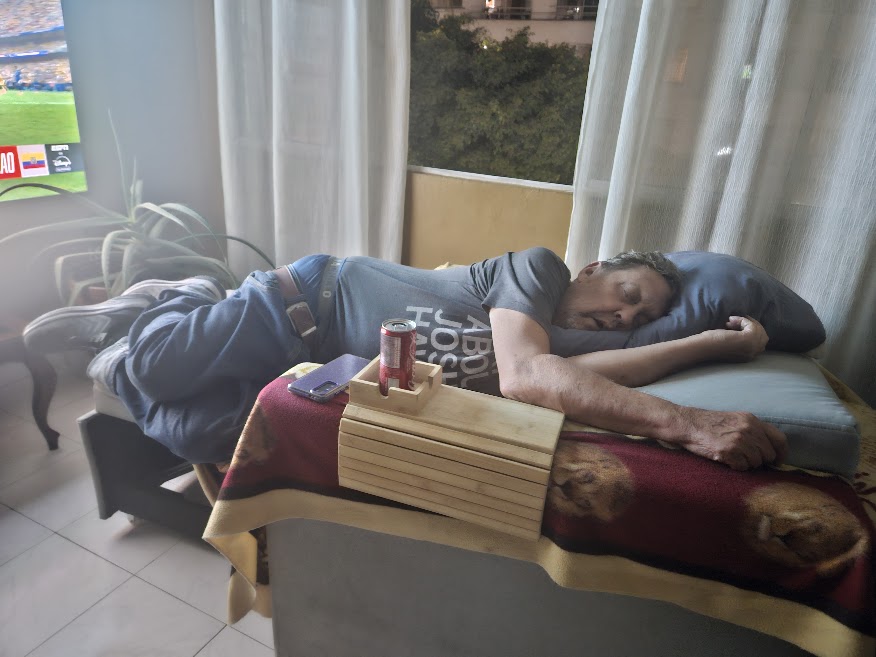
It was versatile and flexible. It was perfect for watching TV, giving and receiving
a massage…or just crashing out after another exhausting day.
He emptied the urinal. He brought medications and food. He asked what he could do. Often there was nothing to do except sit beside me and wait for the pill to work.
The only thing worse than being in pain may be watching the person you love experience pain you cannot stop.
He recorded a few videos, but not many. I do not think he wanted to. He was watching the man he loved cry through the same fifteen-minute ordeal, morning after morning.
It was hell for him too.
My loss of mobility also transferred much of my role in our life to Michael, with heavy assistance from Jackson, who was becoming the most important person in our Colombian lives.
One of our monthly bills had to be paid at a bank only a block away. To me, it was simple: withdraw cash, enter the building, climb the stairs, hand the teller the factura, and pay it. I had done it before. I knew the sequence.
For Michael, every piece was new. He had never gone with me and watched. He had to learn to navigate the ATM screen in Spanish, withdraw the correct amount, enter an unfamiliar building, climb the stairs, approach a teller who spoke no English, and hope he understood whatever happened next. He was terrified of making a mistake.
He took over grocery shopping, other bills, and the ordinary errands he had once been able to ignore because I handled them.
My world was shrinking to the apartment—the balcony, the kitchen, my bedroom, and the bathroom. That was my world, apart from medical appointments, which I did not count.
His responsibilities were expanding into parts of Colombia he had never been required to navigate alone.
Colombia continued coming to me. Groceries and medications arrived through Rappi. The porters taught us the dance of retrieving deliveries from the elevator, sparing us even a trip downstairs. Friends had to visit us. Eventually, even a doctor came to the apartment.
Convenience could disguise the loss. The more efficiently the outside world appeared at our door, the less often I had to enter it.
Pain had started by choosing which sidewalk I would walk on. Then it chose the distance, the time of day, the furniture, the errands, Michael’s responsibilities, and which friends we would see.
Eventually it chose the bed.
• • •
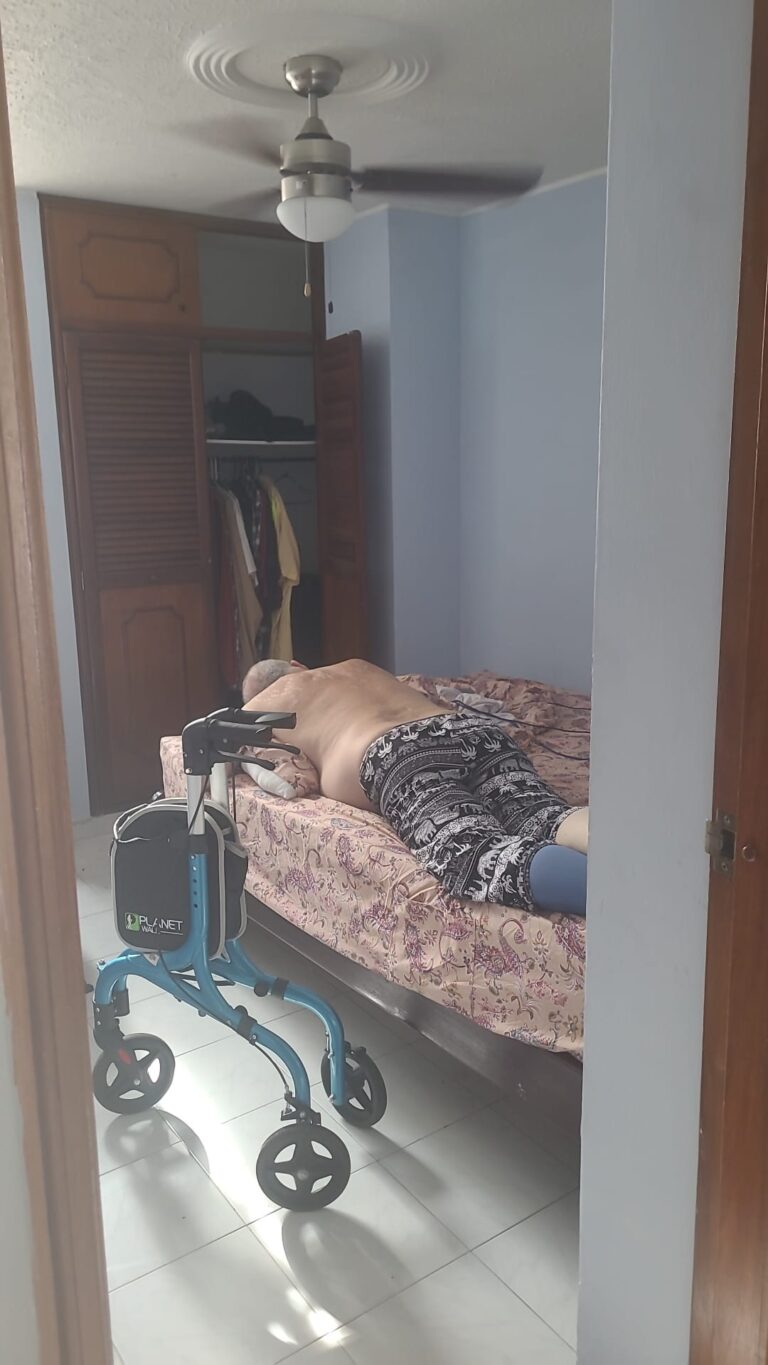
By late June, lying face down became the only position my body would tolerate. Lying on my back hurt. Lying on either side hurt. I ate in bed on my stomach. I urinated into a bottle. In the end, I did not leave the bed at all for two days.
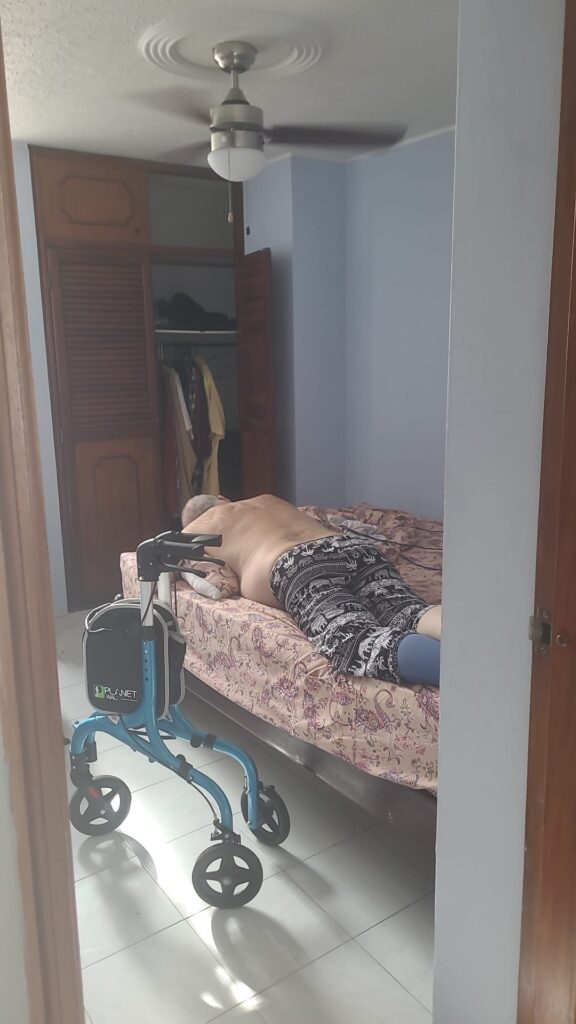
that gave me relief from pain was lying facedown in bed.
I had done my homework before moving to Colombia. I had tried to ask the right questions and answer them honestly. I had assumed that lower costs, private care, an apartment without winter, and a circle of Colombian friends would give two aging men enough room to build a decent final chapter.
Now, face down on the bed, I felt blindsided by everything I had not anticipated.
I also felt foolish. Defeated.
Life is a series of tests, but perhaps the score matters less than what one learns. My favorite language app was designed so that mistakes were necessary. At first, I hated never scoring one hundred percent. Later I understood: if you score one hundred, you are not learning. You already know the material.
Had the move failed?
Had I failed?
I was beginning to suspect that failure might be the price of learning.
That did not make lying there any easier.
Jackson had begun visiting us almost every day. He accompanied me to appointments, translated, and took notes. He was becoming visibly concerned. When he saw me face down and unable to move, he made the decision for all of us.
“I’m calling an ambulance. You have to go to the hospital.”
A little later, he came back into my room wearing a shit-eating grin. The first ambulance company had quoted a ridiculous price. He called another and negotiated a much better deal. He was enormously pleased with himself.
Even in a catastrophe, Jackson had found a bargain.
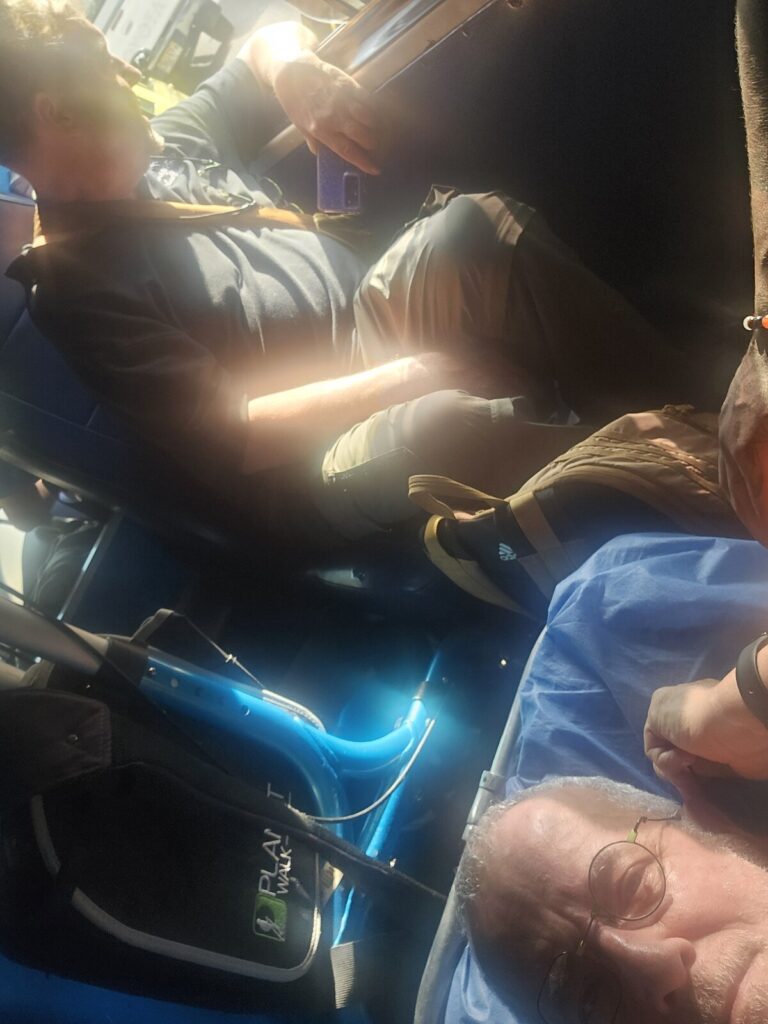
With me. In Colombia.
How exciting.
While we waited, he and Michael went toward the front balcony to watch for the ambulance. Nothing moves quickly in traffic here, not even emergency vehicles. I may have heard the siren arrive. I remained face down, unable to see what was happening.
There was some problem involving the gurney and the elevator. Eventually, a male and female paramedic entered the bedroom. They wanted me to slide from the bed onto the gurney.
I could not move.
I could barely communicate.
Jackson told them, “He can’t move.”
They gathered the four corners of the bedsheet and lifted me with it. I weighed more than two hundred pounds, and I remember being surprised the sheet did not tear.
They transferred me onto the gurney, rolled me out through the building garage, and loaded me into the ambulance.
I worried that the neighbors would see the gringo being wheeled out and I would become fodder for building gossip.
Michael and Jackson were allowed to ride with me. It was my first ambulance ride. I think it was Michael’s first, and Jackson said it was his first too.
The ambulance took us to Urgencias FOSCAL, the emergency department of a modern hospital with a good reputation in Floridablanca, just south of Bucaramanga.
• • •
My memories of the emergency department are unreliable. I was in pain, heavily medicated, and barely able to communicate.
I remember being wheeled into a receiving area crowded with ambulances and gurneys. Nurses and administrative staff kept approaching with questions. Jackson handled the intake.
My gurney and I were parked in a hallway while they decided what to do with me. Jackson said I was in the VIP section. There was nothing visibly VIP about it, although the other areas may have been worse, or at least more crowded.
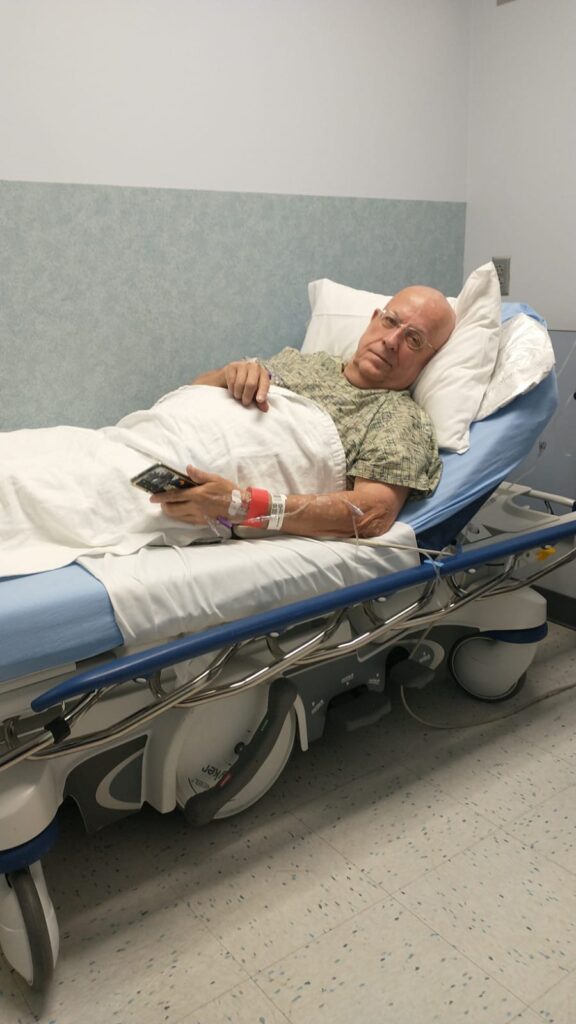
in Bucaramanga thought nothing of parking patients in hallways,
while they waited to be triaged or otherwise evaluated.
Especially so when I found myself being one of them.
But one look at that gurney will tell you that they
were thouroughly modern in other ways.
A doctor triaged me, and eventually I was moved into a curtained cubicle barely large enough for a hospital bed and one chair. Similar cubicles lined both sides of the corridor. A nurse started an IV and gave me medication that finally eased the pain.
After that, time lost its edges.
Doctors came. Meals arrived. At night the unit became noisy. At one point I was convinced somebody farther down the corridor was having a birthday party. Perhaps the medication was making me hallucinate.
The place was medically functional, but it was not comfortable.
Only one person was allowed to remain with me, and that was often Jackson because he could understand the doctors, answer questions, and speak for us. Every so often, he went out and brought Michael in.
The rest of the time, Michael waited outside alone.
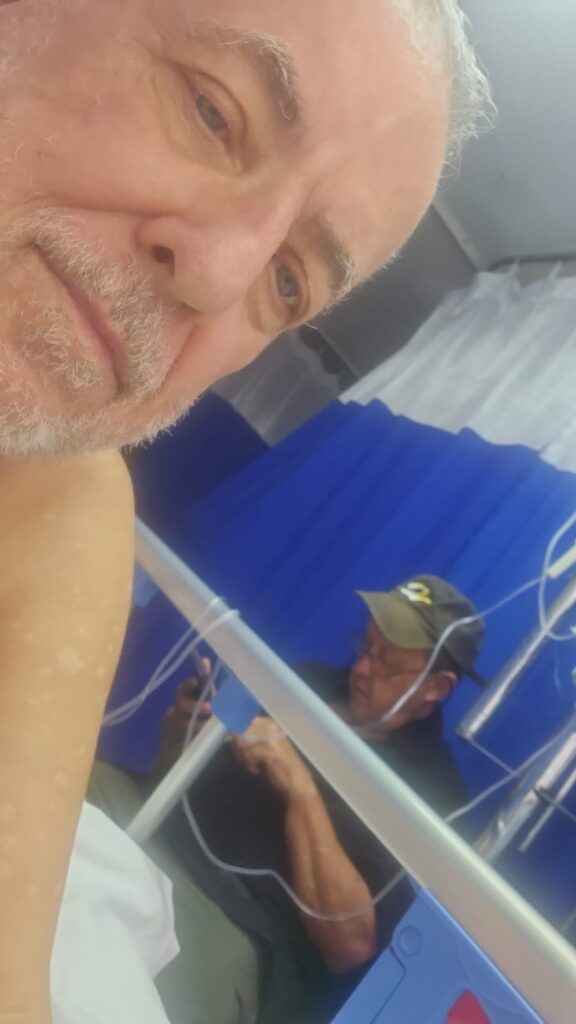
I was never there alone during my 10 day stay.
There was apparently nowhere for him to sit, or nobody thought to show him, so he sat on a concrete step. He could not understand the conversations around him. He did not know whether a delay meant ordinary bureaucracy or disaster. His nature already inclined him toward the worst possibility, and here the worst was visibly plausible.
He sat there for what may have been an hour at a time, waiting for Jackson to come back and translate his life for him.
I had some Spanish, medication, and Jackson beside me. Michael had almost none of that. He was living inside an adventure that had begun with my confidence, and suddenly I—the person who usually made Colombia navigable—was incapacitated.
That concrete step was where my adventure became his ordeal.
After at least a day in emergency holding, I agreed to be admitted to Clínica FOSCAL Internacional. A substantial deposit was required before the transfer—a barrier that keeps care like this out of reach for many Colombians. The sprawling FOSCAL complex remains impossible for me to explain. The hospital was not far away, yet I had to be moved there by ambulance.
Before that happened, Jackson made another command decision on my behalf.
“You need somebody with you every moment,” he told me. “You can’t be left alone here. I’m going to call Javi. One of us will be with you every hour as long as you’re here.”
Even now, remembering that makes me cry. We had chosen a good family.
Javi was with me when the transfer took place.
Once I reached the hospital proper, the first thing they did was bathe me.
A nurse removed my clothes while I lay on the bed. She poured cold water over me, shampooed my hair, and washed every part of my body. Then she rolled me from side to side and pushed the water off the waterproof mattress. She dried me, put me in a hospital gown, and fitted me with a diaper.
It was the first time in my life I had worn one for anything other than a joke.
That was my admission ritual. Even through the haze of intravenous narcotics, I remember it as if it happened yesterday.
The bath ritual happened every morning I was in the hospital. The nurses regarded it as completely ordinary. I hated the cold water, the plastic mattress, and the surrender of privacy, but none of it seemed remarkable to them. My body had become something to be washed, turned, medicated, diapered, and managed.
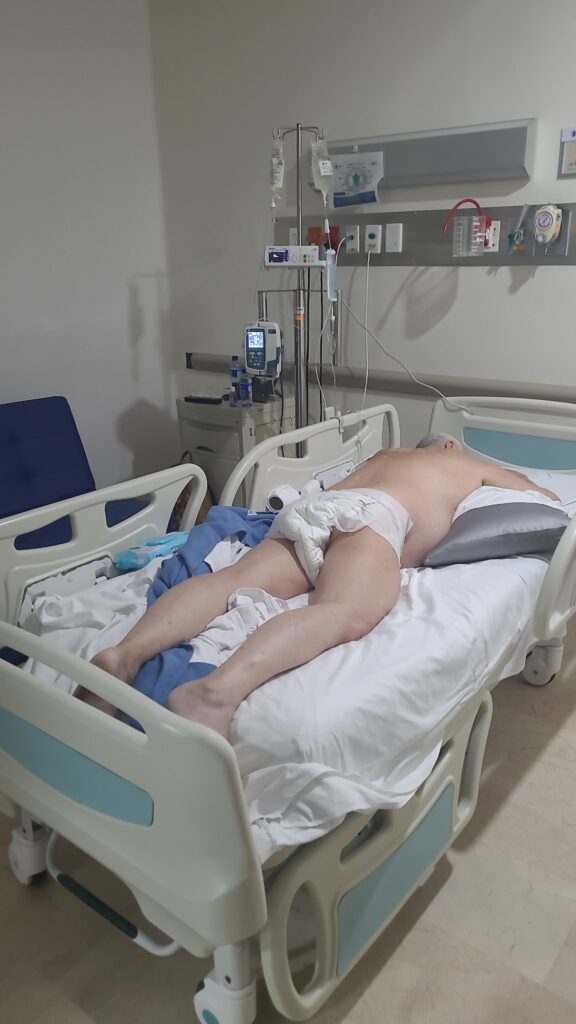
It drove me and the nurses crazy trying to keep the cords and tubes untangled.
I frequently triggered one alarm or another.
Once I reached my room, the hospital itself was nearly indistinguishable from a good hospital in the United States. The differences were minor, and the quality of care was second to none. The food was good enough that I posted daily updates to Facebook with bragging rights.
Every morning, a pain specialist arrived with a team to check my progress and discuss the next recommendation. They ordered another MRI, this one using techniques intended to reduce the distortion caused by the metal already in my spine. They explained what the specialists, including Dr. Carlos, believed to be the underlying cause.
There was one notable plumbing failure, and it occurred at the most inopportune time.
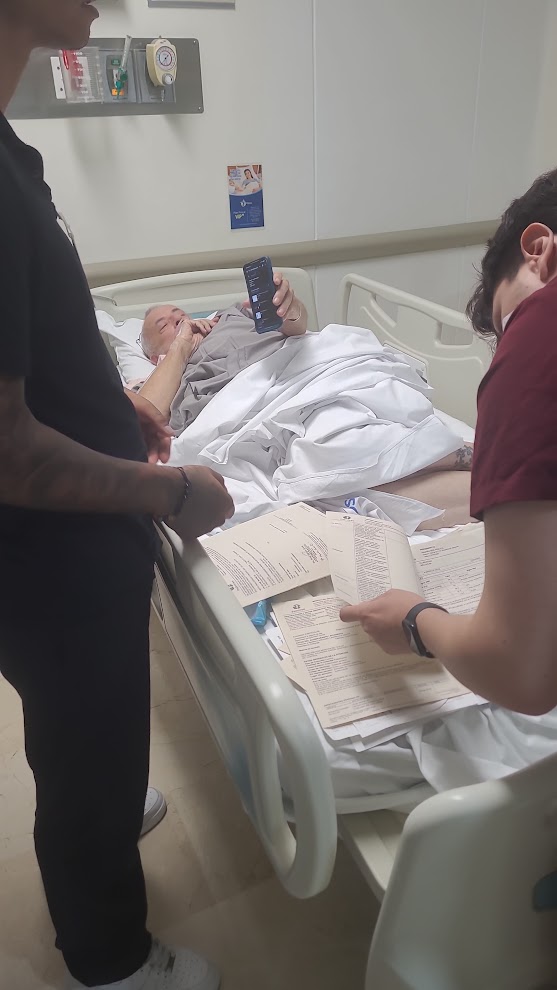
pain clinic staff were not just perfunctory.
The doctors seemed to be in no hurry and were always attentive to my hearing loss as well as my special needs for communicating with a translator.
After nearly a week of constipation, my bowels finally released everything on a night when part of the hospital, including my ward, had lost running water. The automatic toilet, which ordinarily flushed every twenty seconds whether anyone wanted it to or not, would not flush at all.
The bathroom began to smell like a barn full of wild animals.
I tried everything, including the manual override, and was certain nothing more could be done except endure this new humiliation, over which I had absolutely no control.
When Javi arrived an hour or two later, he was equally certain he could fix it.
He bravely entered the bathroom, somehow forced the toilet to flush manually, emerged triumphant—and promptly closed the door tight for the rest of the night.
Love in a hospital is rarely cinematic. Sometimes it sits on concrete. Sometimes it negotiates an ambulance. Sometimes it makes a schedule so you are never alone. Sometimes it walks into a bathroom nobody else wants to enter and solves the problem.
While my friends kept me human, the doctors kept working the problem.
Dr. Carlos and I had not always seen treatment the same way, but I respected his skill. Eventually, he and the hospital team performed a nerve ablation intended to interrupt the pain signals. While waiting to be transferred to the procedure table, I made a wisecrack about hoping my credit card would not be declined—the sort of joke only a foolish gringo would make to a Colombian doctor just before going under. Again.
The next day, a physical therapist came to my room.
Only ten days earlier, four people had used a bedsheet to lift me from my own bed because I could not move. Now I stood with very little assistance.
Then, with the security of my trusty blue walker, I took a step.
Then another. I struggled to trust what I was feeling, seeing, and doing. I walked a little way down the hall and returned to my room—my new safe zone.
Michael recorded it.
I posted the video on Facebook with a title:
Look at me. I can walk again.
Stay tuned for Part 5. This story isn’t over yet.