I came to Colombia with honorable intentions of telling other people’s stories.
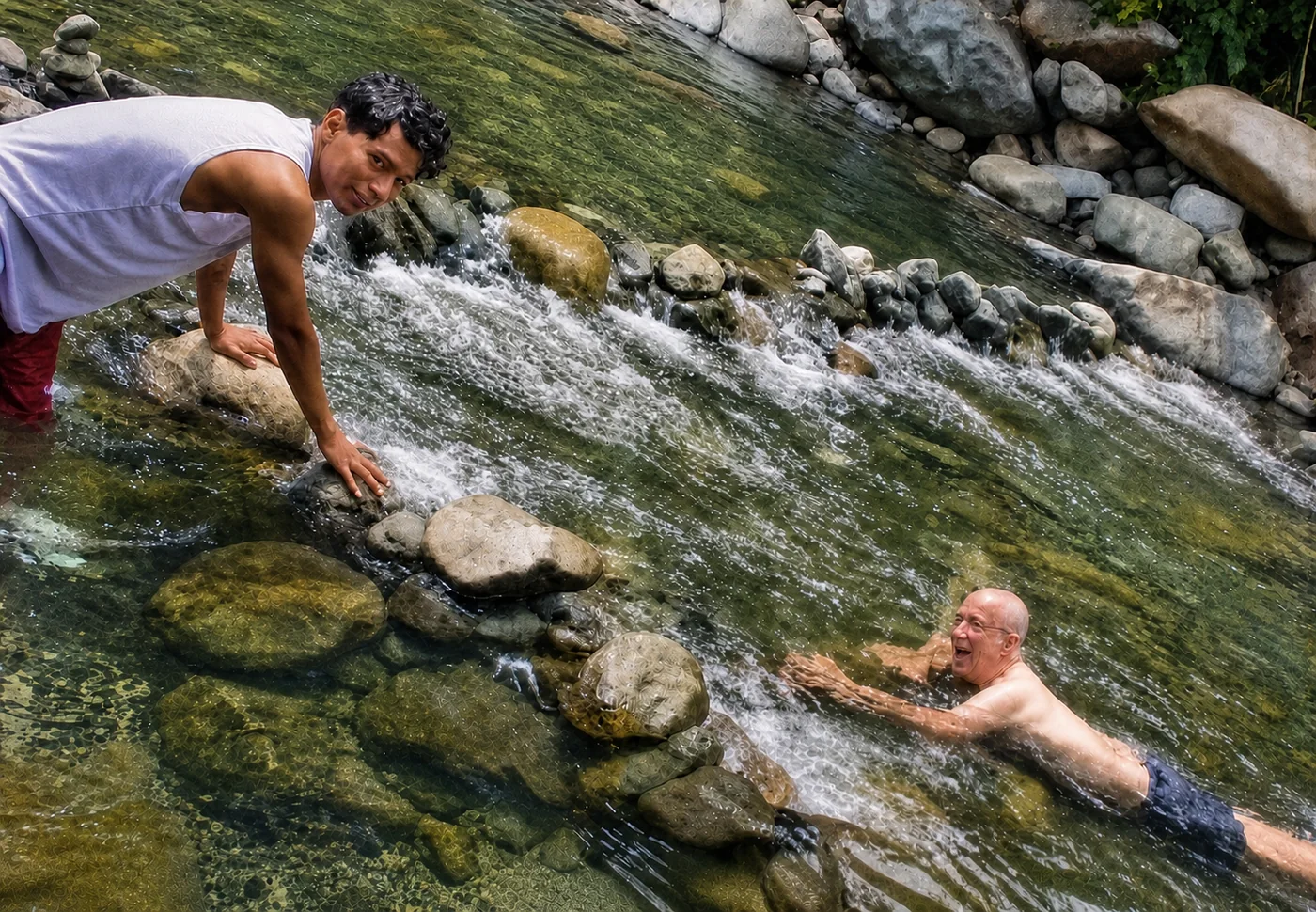
Brandon keeping an eye on the gringo Papi.
That was part of the dream. I made a big deal about it on social media before Michael and I left Kansas City. I bought recording equipment. I researched sophisticated translation protocols, hoping to overcome the language barrier, for myself and for my target audience, other gringos. I imagined normal, spicy conversations with young Colombian men talking about family, work, love, ambition, sexuality, and what a Colombian life is supposed to be.
In the United States, we have something we are taught to call The American Dream, as if we — US — are the only people in the only country on the continent, or even in the Western Hemisphere, entitled to dream in capital letters. Colombia has something else. I have ideas about what that something might be called, but I am not Colombian, and therefore cannot define what being Colombiano means.
But I wanted to try. The point, at least in my nobler version of the story, was to listen and present those conversations to other gringos as something unique, special, and maybe worth learning from, if not aspiring to. Let’s be honest, though. I grew up in a colonial country with a colonial imagination. Part of me also imagined subsidizing our adventure by writing stories that were not only cultural, but erotic; not only honest, but marketable; not only curious, but dangerously close to exploitative if I was not careful.
Instead, not long after we arrived in our chosen version of retirement paradise, my skeleton chose to manifest hell on earth.
Michael and I moved to Colombia in late June 2025. I wanted to arrive and get settled a bit before my 69th birthday on June 30 and replicate the previous year’s celebration with Javi and Suli, in the country that had become the set location for one more attempted reinvention near the end of our lives.
A year later, I spent my 70th birthday in the hospital.
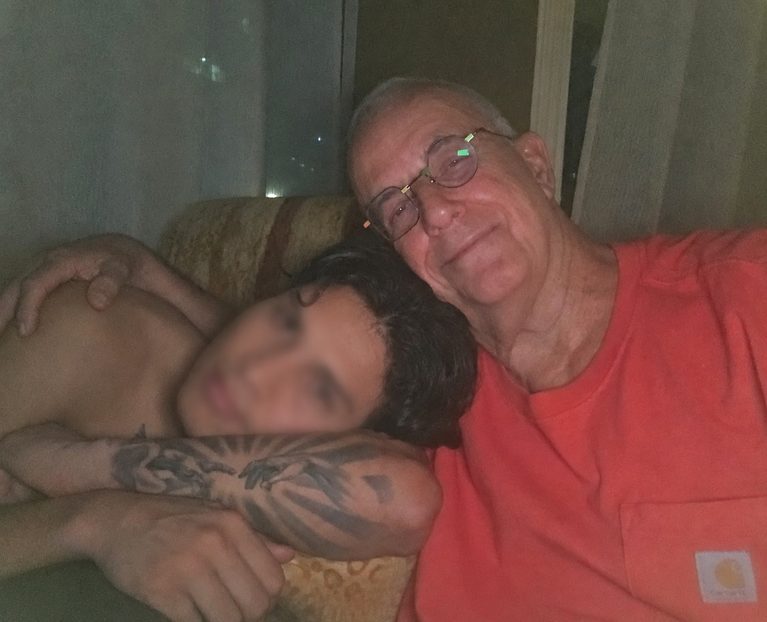
At least I wasn’t alone.
Thank you, Javi and Jackson.
When I was discharged from FOSCAL Hospital on July 4, after ten days in the hospital and a nerve ablation, there was no fireworks show. But I had enough reason to celebrate my own personal Independence Day. The pain had stopped. Or, as it turned out, taken a hiatus.
For about three weeks, the Pain Demon loosened its claws on my old, weakened skeleton. The hydrocodone and the hospital drugs had cleared my system. My muscles began to accept the almost laughably minimal physical therapy needed to relearn that they could carry me. I was happy again in my rolling chair in the kitchen, cooking my unique, if not peculiar, gringo fusion meals for our amigos colombianos.
Roasted garlic was a big winner.
The doctors had cautioned, “No promises.” But hope heard only that many people experience months or even years of relief from an ablation. Instead, my body apparently heard three weeks. Max. As is too often the case here, something was lost in translation.
That brief clearing in the storm restored enough physical energy and brainpower for me to write Running Away to Colombia, with editorial collaboration from Erasmus, my AI agent.
Five long essays. Too long for the attention span of most readers today, probably. Too many words. Too much history. Too much Jon. But this written documentation of my adventure mattered to me then, and it still matters now. Maybe more so.
Together, they tell how Michael and I uprooted our very established and boring lives in Kansas City, moved to another country on another continent with another culture and language, and pursued what promised to be a comfortable, if not exotic, new life at perhaps the craziest possible time for two old gay gringos to make such a leap. Even the briefest review of my medical history is a flashing red light warning against such nonsense.
Those essays were not the stories I came to Colombia to write. They were the story that insisted on being told first. Pain had commandeered the driver’s seat of my life, and for this brief spell, at least, I was able to take control again.
I did not intend to give it up.
I thought, when I finished Part 5, that I had done what needed to be done. I had documented the decision, the dream, the fear. I had described the arrival, the hope, the mistakes — many mistakes — the latest crisis, and the inevitable questions hanging over us now.
But the story had a different idea.
It did not end. It refused to leave well enough alone. When will I learn that isn’t how life works? At least not mine.
It moved into real time.
The Pain Monster returned, and it did not sneak in gradually or quietly. It came crashing through the door like a drunken, aggrieved ex one morning as I tried to get out of bed. I have been in worse shape. I can still manage the pain, for lack of a better word for what I am doing now. But this was a complete betrayal of what seemed to be a successful resolution of the pain I had been fighting for months, the pain that eventually put me in the hospital.
I am writing this after another badly disrupted night. I do not dare sleep more than a few hours at a stretch, day or night, because the longer I stay horizontal, the worse the pain can become when I try to get up. Sometimes now, thanks to the pain meds, I have to pause and recapture thoughts before they slip away.
I was able to publish the long series last month only because, briefly, freedom from pain-numbing drugs coincided with enough energy and mental clarity to do it. Now both are under negotiation again.
The story is not finished.
It has insisted on a sequel. To add insult to injury, it has succeeded in winning another concession from me: a higher dose of hydrocodone.
Which brings us to Ko-fi. Pronounced coffee, I think.
Michael and I have opened a Ko-fi campaign because we need to ask for help.
There is no elegant way to say that, and I am not going to decorate it trying to make it disappear. Yes, it is a fundraiser. The driving force is money. Or lack thereof. Let us be honest about that upfront.
But the need is not simple, because nothing about our situation is simple. Nothing is easy to define. Nothing stays static for long.
It is true that medical care here costs far less than medical care in the United States. The quality can be high, though the system is different in ways that are hard to explain until you are inside it. Another Colombian contradiction.
But the comparison that matters most for us is not Colombia versus the United States.
It is insured versus uninsured.
In the U.S., we had Medicare and supplemental plans that we paid for out of a fixed Social Security income. That supplement premium was our single largest monthly expense, but together the coverage gave us access to extraordinary medical care. Here in Colombia, I am not eligible for government-funded care, and I cannot buy a useful private plan that covers the pre-existing conditions most likely to land me in trouble.
So yes, ten days in a Colombian hospital cost far less than ten days in a U.S. hospital would have cost. It was still a sizeable four-digit blow we were not prepared to absorb. I had sworn I was not going to let that happen.
That was before I met the Pain Demon.
I spare you, dear reader, another verbose detour for now. When I left the hospital, the bill went onto a credit card. That is the key message I am trying to make here and now. Our savings were already disappearing, thanks in no small part to all the medical tests, examinations, and treatments I had been consuming since last year and which continue to this day. I also need a wheelchair soon if I plan to go to the park or the market again. Taking an Uber two blocks to buy food seems, well, excessive.
Someone could reasonably ask how we ended up in such a hole. Why didn’t we plan better? Why did we let so much money get away from us so quickly?
We have asked ourselves those questions too.
We were living an ordinary, for us, day-to-day life and sometimes spending more than we should have. We could have controlled some of that better. But how does anyone predict the exact day when a complex living body will have a system failure? We had tried to do our due diligence. We even spent a few thousand dollars on a two-year international insurance plan to satisfy Colombia’s visa bureaucracy, knowing that much of it was probably the cost of doing business rather than useful protection.
I mean, pre-existing conditions, anyone?
Then came the hospital. Here, deposits were required before treatment could continue. The credit card let us kick the can down the road while ordinary bills kept coming: rent, building administration, water, electricity, internet, food, medication, transportation.
The machinery of ordinary life does not stop because the body has declared an emergency.
When the first Ko-fi gifts arrived a week ago, I was preparing to tell our landlady, Doña Gloria, that rent would be a few days late, until we received our monthly Social Security checks. She would have accepted that. She would not have charged a fee. But she would have noticed. We have been good tenants in part because we pay on time and do not often make excuses.
Because of the people who responded early to the campaign, we are now able to pay the rent on time, assuming the money completes its ridiculous little pilgrimage quickly enough: Ko-fi to PayPal, PayPal to the credit union, through international transfer systems and the conversion rate, into Bancolombia, and finally to Doña Gloria’s account.
Everyone who touches the money takes a cut along the way.
That is a story for another day.
For today, the simple truth is this:
The first gifts have already changed something real for us.
They turned an apology into a payment.
That does not solve the crisis. It does not come close. But it matters.
At first I prepared myself for silence, or maybe a few $5 and $10 gifts: old-fashioned crowdfunding, with many people giving something so small that it was hardly noticed until those tokens accumulated and became something much more substantial. But my online presence is not so grand. I have no crowd following me.
Jajajaja.
The early responders surprised me in other ways. Help came from people I would never have thought to ask directly: old friendships that had not been present in my life for a long time, almost-lost friendships, people who had drifted to the edges of my life, or I to the edges of theirs. One gave an amount that made my jaw hit the floor. Other gifts followed, some accompanied with a note of recollection:
“I’ve watched you care for your community for probably 40+ years now. Community matters.”
Another generous donor remembered me from my years as an outspoken AIDS dissident. What mattered here was not reopening every old argument about HIV or antiretroviral drugs. It was that he remembered the honesty with which I eventually told what happened to me, even in circles where that honesty was unwelcome.
A connection from a complicated period of my life had survived long enough to reach back when I put my hand out.
Some gifts were $0.
But I count them among the most valuable.
Ian, a long-time friend in Cali, wrote:
“Hola Papi. I know you’re going through a tough time right now. They still haven’t paid me. As soon as I have some money, I’ll send it to you. I love you so much. You’re not alone.”
Ian is young enough to be my grandson, or gawd, maybe great-grandson, and I’m not going to do the calculations to find out now. His world had just been shaken, literally, by a once-in-a-lifetime earthquake. He was surrounded by disaster and destruction, but he held me up. I know he will never be able to send money, and if he did I would return it. But in this new culture, I accept his unsolicited gift as it was intended.
When he received his HIV-positive test result many years ago, he had no one to talk to.
No one except me, his virtual gringo friend.
His gift will never register on the Ko-fi total, but it is registered in my memory and my heart.
Messages from older peers who remember me serving the Community forty years ago reach places in my body and my mind that money cannot venture. They gently and carefully nudge neurons in my declining white matter. They massage some of the muscles in my heart that have seen better days. They remind me that community can be wider, stranger, and more durable than my current contact list can represent.
That is one reason we are now moving beyond Facebook.
A campaign is not something one can post once and then stare at the total. It means asking who still does not know the story. Who knew us in Kansas City, through queer activism, business, writing, AIDS work, community fights, friendships, arguments, old bars, old meetings, and old versions of ourselves? Who else might care if they only knew what was happening now?
What is happening now is that we are trapped.
Not trapped in Colombia, exactly. That would be too simple, and not quite true enough.
Colombia still has not lost its significance for me, despite all that I have endured here. Nor has it for Michael, though our experiences are different. I still love much of what drew me to this country. Frankly, I do not want to leave it. In some ways I feel more emotionally at home here than I expect to feel back in the United States.
Surprisingly, perhaps, Colombia also represents options for medical and end-of-life autonomy that matter deeply to me. This is no secret, and I am not making a dramatic announcement here. I have already shown how badly I tolerate losing control of my own life. I cannot abide having no option other than waiting until the Pain Demon decides that I have suffered enough to move on to my next cosmic home.
That subject deserves its own post. Or two. For now, it is enough to say that I need options. I need control. I need to know that my choices about my own body and pain will not disappear simply because the situation became too frightening or too inconvenient for other people to discuss.
But Michael’s needs are not identical to mine, by a long shot. We have always been a contrast in personalities, abilities, and needs. Sometimes it is a complementary contrast that produces thoughtful balance. Other times we are that nagging old couple who make you wonder what the hell they saw in each other and how the fuck they stay together.
Jajaja.
For Michael, English is not a luxury. Familiarity is not a luxury. The possibility of U.S. support systems, however imperfect, is not theoretical. He needs a place where he can communicate, navigate, ask questions, understand instructions, and not feel as if every ordinary task requires crossing a river with no bridge. Especially if and when I’m no longer here with him.
So yes, Kansas City has become the default plan.
That sentence is harder for me to write than most people will understand. Kansas City was my home from the time I was 21 or 22. Since moving to Colombia, I have trained myself to stop calling the United States “home.” Now that word keeps returning as useful shorthand, and every time it does I feel the need to clear my throat. Or deal with a sudden jolt of acid reflux.
Kansas City may be where we have to go.
Yet even that is not so simple.
Returning to the United States is not a matter of buying two cheap plane tickets and packing underwear.
My body may not tolerate ordinary travel. If the Pain Demon has dislodged me from the driver’s seat of my life, what will it do with a one-way ticket home? A basic coach fare seat may be impossible for me, and even business class is not magic if a pain flare leaves me unable to lower myself into it without screaming, let alone trying to exit. We can arrange tickets, bags, airport help, and transfers, only to discover that my body refuses to cooperate at the worst possible moment.
The help waiting for us at the airport may need to be an ambulance ready to take me to the hospital.
That is not catastrophizing. It is planning in the body I actually have now. Landing in Kansas City will not change that reality. Crossing the Gulf of the Americas and an international border does nothing to make my body safer or the risk less real.
Junior told me more than once, “Papi, where there’s a problem, there’s always a solution.”
He is often right. And I will continue trying to remain open to any solution the Universe — through reality, magical or otherwise — presents to me.
I may not like the solution, but there is usually some path. That is one of the things Colombia has taught me, or at least forced me to consider. Problems are not always walls. Sometimes they are doors with expensive locks.
Every solution arrives with a price tag.
Another block or ablation. A spinal-stimulator trial costing thousands just to learn whether it works. An implanted pain pump holding perhaps a year’s supply of morphine, or something like it, to be microdosed directly into my spine. A useful electric wheelchair built for Colombian terrain. Business-class airfare. Help with packing, lifting, translation, medical appointments, documents, transfers, and the thousand small tasks that aging and pain turn into cliffs, not steps.
All of it costs money at exactly the moment there is none left over.
Do I sound indecisive about where we’re going and what we’re going to do? Conflicted?
Yes.
All of the above and more.
Michael has said that one of the hardest parts of the status quo is the constant flux: the pendulum swinging, one door slamming shut while another opens — sometimes only a crack, teasing us with a path we had not seen before. Or just as likely, a path we already knew about, had to discard, only to discover there was something about it that suddenly puts it back in play.
That is why the Ko-fi campaign is not only about a hospital bill, rent, or airfare.
It is about buying or maybe renting enough time, help, treatment, mobility, and decision-space to find a safe, viable way forward. The most obvious drop-dead deadline is January 27, 2027, when our visas expire. Between now and then are the unknown and unseen surprises, hopefully none involving another ambulance.
Maybe the way forward is Kansas City. Maybe it is a temporary bridge in Colombia if the missing pieces of support can be found or replaced. Maybe it is something we cannot see yet because pain, fear, hydrocodone, and exhaustion have narrowed the view.
But we need enough help to make the next decisions deliberately, not merely because the clock, the bank account, or the Pain Demon made them for us.
The Ko-fi campaign is here:

If you can give something without depriving yourself, please consider helping us.
If you cannot give money, please share the campaign or this post with people who may know us, remember us, or care about the communities we come from. A campaign works only if it travels beyond the circle that already knows us and our story.
Comments help more than you might realize, too. Tell us what you see. Tell us what you remember. Tell us how much of the story you have followed.
I thought that Running Away to Colombia had finished the story.
It did not.
The story is still happening.
And we are asking you to walk beside us while we find out where we can safely land.
We pledge to keep you informed as best we are able.