Running Away From Colombia — Part Two
People came into our home and carried our life away.
Five dollars.
Twenty dollars.
Make an offer.
Take the whole box.
That is what an estate sale does. It converts biography into price tags.
We scheduled ours for the first weekend of May 2025. Looking back, that weekend became the point of no return, although I did not experience it that way at the time.
I wish I could tell you there had been one beloved heirloom, one final object that carried the emotional weight of leaving America.
Maybe there was.
I do not remember it.
Michael probably does.
I can’t even find many photographs now, which surprises me. Maybe that’s appropriate. Estate sales don’t leave behind many memorable pictures.
If you’ve been to one moving sale, you’ve been to most of them.
Tables covered with the accumulated evidence of a long American life. Kitchenware. Furniture. Decorations. Tools. Books. Objects we had bought, inherited, forgotten, rediscovered and moved from one home to another. Things that had once represented taste—or the lack of it—comfort, possibility, or simply something that had once seemed too good a bargain to pass up.
People wandered through the rooms, picked things up and asked what we would take.
I sometimes wondered whether the neighbors came to buy anything at all or simply to see what had become of the house we’d spent so many years remodeling into something uniquely ours.
Possessions are little traps for memory.
That does not make them valuable at an estate sale.
At an estate sale, memory is not included in the price.
The lamp is five dollars.
The box of dishes is ten.
Take both and we can make a deal.
If there was a single moment when Colombia changed from fantasy to decision, this was it.
There had been research, paperwork, conversations, lists, numbers, arguments and a great deal of pretending that practical planning and emotional certainty were the same thing.
Then we scheduled the sale.
Until that point, Colombia was still reversible.
We could change our minds.
Delay.
Decide we had been romantic, reckless or simply too old to reinvent our lives one more time.
But once the furniture began leaving the house, the decision acquired weight.
Or perhaps it lost weight.
The sofa went.
The dining table went.
The shelves emptied.
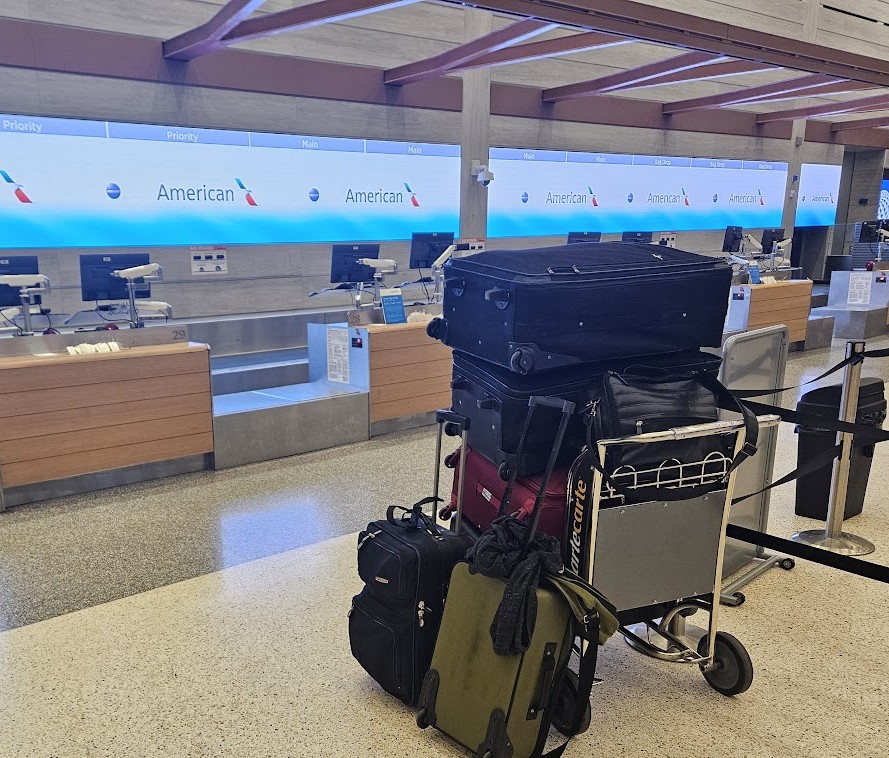
We were allowed four suitcases.
We also kept a small storage space.
Everything else had to justify itself or leave.
A suitcase is a brutal editor.
It does not care whether something represents who you used to be.
It does not care whether you bought it during a happy year, inherited it from someone you loved or carried it through five previous moves.
It cares only how much it can physically hold.
The airline cares how much it weighs.
Shoes occupy more room than memories.
Medications travel before photographs.
Documents outrank souvenirs.
The final decisions proved harder than we expected.
More than a year later, a few of them still puzzle me.
The portable version of a life turned out to be remarkably small.
I do not remember sobbing as strangers carried our belongings away.
I remember work.
I remember fatigue.
By then, emotion had become inefficient.
In hindsight, the aching back deserved more attention than I gave it.
Michael felt the loss more sharply than I did.
He fought harder to keep things and insisted that we store several boxes of memorabilia we could not take with us.
Months later, when he returned to Kansas City, he went back to see what we had saved.
Nostalgia was waiting for him there, carefully boxed.
It did not give him back the life those objects had belonged to.
Looking back, I knew we were taking a risk.
I also knew that staying carried risks of its own.
Those were never the hard parts.
The hard part is that some decisions cannot be judged while you are still living inside them.
I am more frightened today than I was when we boarded the airplane.
Experience has a way of sharpening both hope and fear.
I understand the risks better now than I did then.
But do I regret leaving?
I honestly cannot tell you that I do.
Regret has a way of pretending there was a safe path.
I no longer believe there ever was.
Politics was not scenery in this decision.
It was the engine.
Like many Americans of our generation, Michael and I spent years watching the United States become a country we no longer recognized as our own.
We felt its cruelty hardening, its democratic promises weakening and its appetite for humiliation becoming a form of public entertainment.
We did not believe we could repair it.
We no longer trusted it to leave people like us alone.
For years my Facebook profile has carried a simple sentence:
“If you can’t save the world, find a good seat for the sunset.”
That heartbreak made Colombia more than an adventure.
It made departure feel necessary.
I said I would not go back.
I meant it.
Leaving was a gamble.
Staying was also a gamble.
Only one of them still contained surprise.
Michael and I had been together for more than forty years.
We had survived illnesses, economic crises, failed business schemes, grief, epidemics and Kansas City winters.
At least we still had each other.
But this was different.
We were not moving across town.
We were preparing to leave the country where both of us had spent nearly all our lives.
There is an accusation hidden inside the phrase running away.
Cowardice.
Avoidance.
Refusal to face reality.
I have run away from things in my life.
Problems.
Shame.
Failure.
But running away is not always the opposite of courage.
Sometimes the burning building really is on fire.
Sometimes departure is the most honest thing a person can do.
We were leaving behind more than our possessions.
We were leaving the familiar American script.
Work.
Save.
Own a house.
Age in place.
Use Medicare.
Enter the appropriate facility when the body fails.
Die somewhere between safety rails under fluorescent light.
That script works for many people.
It may even be a good one.
It was not the life I wanted then.
It is not the life I want now.
We did not know what Colombia would give us.
We knew what staying would mean.
By the end of the estate sale, the house looked less like a home than evidence after a raid.
Spaces opened where furniture had stood.
The rooms seemed larger and less intimate.
Pale rectangles remained on the walls where pictures had protected the paint from time.
The house was still ours.
But it had stopped supporting the illusion that our life there would continue.
There was no trumpet blast.
No swelling music.
No final speech.
The door closed.
The rooms were emptier.
Empty rooms have a way of making decisions look more serious.
We were no longer thinking about moving to Colombia.
We were leaving.